The most improbable reincarnation
Diego Maradona Jr. comparing Scott McTominay to Jesus is the kind of quote that usually requires a cold compress and a dark room. According to The Mirror, the former Manchester United academy graduate is now viewed in borderline religious terms in southern Italy after a string of dominant performances. It is a sentiment that would have fundamentally broken the brains of regular Old Trafford match-goers just two years ago.
But when you strip away the Neapolitan theatrics and the heavy, unavoidable weight of the Maradona name, what remains is a fascinating tactical resurrection. McTominay has not suddenly learned how to manipulate space like Xavi or dictate tempo like Toni Kroos. He is simply playing in a tactical framework that finally understands, and actively exploits, his bizarre, highly specific statistical profile.
To truly understand the success he is enjoying in Serie A, you have to look back at the wreckage of his time as a deep-lying midfielder in England. For years, successive Manchester United managers deployed him as a standard defensive pivot, usually alongside Fred. The resulting metrics were consistently grim.
The Old Trafford baseline
At his lowest ebb in Manchester, McTominay was averaging barely 35 passes per 90 minutes. For a central midfielder in a team aspiring to dominate possession, that is an alarmingly low figure. He was a player who actively avoided the ball in the first phase of build-up.
Match-going fans grew increasingly vocal in their frustration. They watched a player who frequently pointed to feet rather than stepping into pockets of space to receive on the half-turn. The analytics community was equally damning. During his peak years operating in a double pivot, he consistently ranked in the bottom 30th percentile among European midfielders for progressive passes.
He was repeatedly asked to dictate the tempo of the game, a role he was fundamentally unsuited for. He is not, and has never been, a deep-lying playmaker. The defensive numbers were always fine—his tackle and interception rates frequently broke 4.0 combined per match—but modern elite football requires a pivot to break lines, not merely break up opposition attacks.
He was essentially a target-man striker trapped in the tactical responsibilities of a holding midfielder. It was a failure of coaching imagination as much as player limitation.
The Scotland blueprint
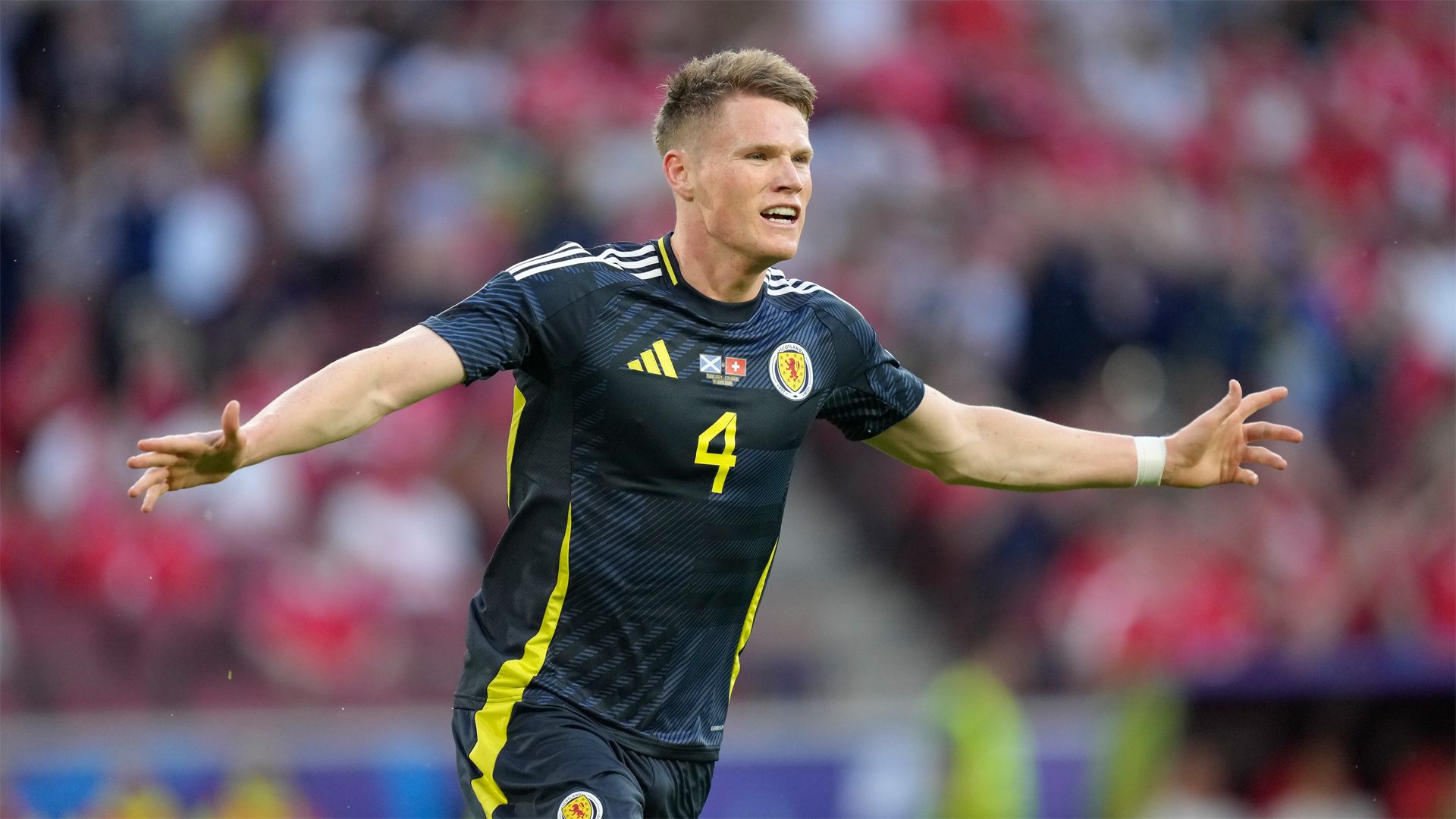
The blueprint for this Napoli explosion was actually written by Steve Clarke. The Scotland national team manager realised long before the club coaches that McTominay's distinct value was entirely located within the width of the penalty area. During the Euro 2024 qualifying campaign, the tactical shift was stark, immediate, and wildly successful.
Clarke entirely bypassed the midfield build-up phase when it came to his talisman. McTominay scored 7 goals in that qualifying run, operating almost as a shadow striker playing off Lyndon Dykes or Che Adams. The statistical efficiency of this role was staggering.
During those international fixtures, he averaged fewer than 25 touches per goal. He was not involved in constructing the attacks; he was exclusively utilized to finish them. His aerial dominance became a primary, unstoppable weapon against deep defensive blocks.
Standing at 6-foot-4, his win rate in aerial duels consistently tops 65 percent. But crucially, he was no longer winning defensive headers from corners; he was attacking the back post with the violence and precise timing of a classic 1990s number nine.
Translating the metrics to club level
That international form finally forced a change at club level during his final full Premier League season. Pushed higher up the pitch out of sheer desperation by Erik ten Hag, the underlying numbers shifted dramatically.
McTominay bagged seven league goals from an expected goals tally of just 4.2 xG. He was outperforming his underlying metrics by a ridiculous margin. He was no longer a liability in possession because he was rarely required to keep it; he was simply asked to arrive in the box and convert half-chances.
His shot map from that final 18-month period in England tells the whole story. The data points are almost entirely clustered within the radius of the penalty spot. There are no speculative long-range efforts, only high-percentage, one-touch finishes from cutbacks and crosses.
The modern Mezzala profile
To fully grasp his utility in Italy, we must look at the historical context of the Serie A midfield. The league has a long tradition of utilizing physically imposing, goal-scoring midfielders—the classic inseritore. Think of players like Arturo Vidal during his peak Juventus years, or Sergej Milinković-Savić at Lazio.
These players were never the primary playmakers. Their job was to act as a battering ram, breaking defensive lines through sheer physical force and arriving in the box to finish moves constructed by deeper, more technical teammates. McTominay is currently operating as a budget version of this specific archetype.
By surrounding him with technically secure midfielders like Stanislav Lobotka, Napoli has effectively insulated him from his own weaknesses. Lobotka handles the first-phase progression, dropping deep to receive off the center-backs and navigate the initial press. This division of labor is crucial.
It frees McTominay from the burden of ball circulation. His tactical instructions are stripped down to their most primal elements: press the opposition number six out of possession, and sprint into the penalty box the moment Napoli transition into the final third. It is a highly demanding role physically, but cognitively, it is beautifully simple.
Why the Italian setup works
Moving to Napoli provided the structural discipline he severely lacked in a chaotic, transition-heavy Premier League environment. In Serie A, the average engagement line is often slightly deeper than the relentless, manic high-pressing of the English top flight.
The game state is generally more controlled. This subtle shift in pacing gives a technically limited player a fraction more time to orient himself. If you do not press McTominay instantly upon receiving the ball, his primary weakness—turning under severe pressure—is neatly hidden.
Furthermore, Napoli utilizes him perfectly within the context of the mezzala role. He is allowed to be the ultimate third man running. While the wingers and the primary striker occupy the opposition center-backs, dragging them out of position, McTominay arrives late into the penalty area completely unmarked.
It is a simple tactical concept, but it is executed with devastating physical efficiency. He covers immense ground, frequently averaging over 11.4 kilometres per match, ensuring he can contribute to the defensive shape before sprinting 40 yards to join the attack.
"He remains a leading light at Napoli and the ex-Manchester United ace has been likened to Jesus by the son of Diego Maradona."
The quote from the source article highlights the deep emotional resonance of his impact on the fanbase. But the tactical reality is purely mechanical. He is providing a late-arriving box presence that forces opposing defensive lines to collapse inward, which in turn frees up vital space for Napoli's creators on the flanks.
The glaring limitations
However, no serious analytical piece is complete without acknowledging the structural flaws. Let us not pretend he has suddenly morphed into an elite, all-phase midfielder. The underlying data still shows a player who struggles fundamentally when forced to break lines from deep.
If an opposition manager does their homework and isolates him against a coordinated pressing trap in the middle third, the turnover rate still spikes alarmingly. His pass completion under high-intensity pressure remains stubbornly below 75 percent.
When forced to play facing his own goal, the old anxieties immediately return. This is a major tactical liability in elite knockout football. Against top-tier Champions League opposition who counter-press relentlessly, carrying a central midfielder who cannot consistently play out of tight spaces is a dangerous gamble.
Napoli's coaching staff will have to scheme around this limitation constantly, ensuring their deeper midfielders handle all progression duties while McTominay pushes high to pin the opposition backline.
The Maradona Jr. comparison is wildly entertaining hyperbole. It speaks to the passion of a city that readily embraces hard-running, physical commitment and sudden bursts of goalscoring form. But the numbers tell a colder, far more precise story. McTominay is a highly specialized, tactically limited weapon who has finally found a system willing to hide his flaws and violently exploit his singular elite trait.
Read Next
- Max Allegri faces a tactical nightmare against Napoli this weekend
- Man United's manager paralysis and Arsenal's cup final hangover
- Arsenal are playing Russian Roulette with Alessia Russo's best position
- Alessia Russo is Arsenal's Swiss Army knife and it might be a problem
- 🏴 Scotland World Cup 2026 — Tartan Army Hub
- ⚽ Serie A 2025-26 — Title Race Hub (Inter, Napoli, Juve, Milan)
- ⚽ Scottish Premiership 2025-26 — Celtic vs Rangers Hub