The optics of defeat
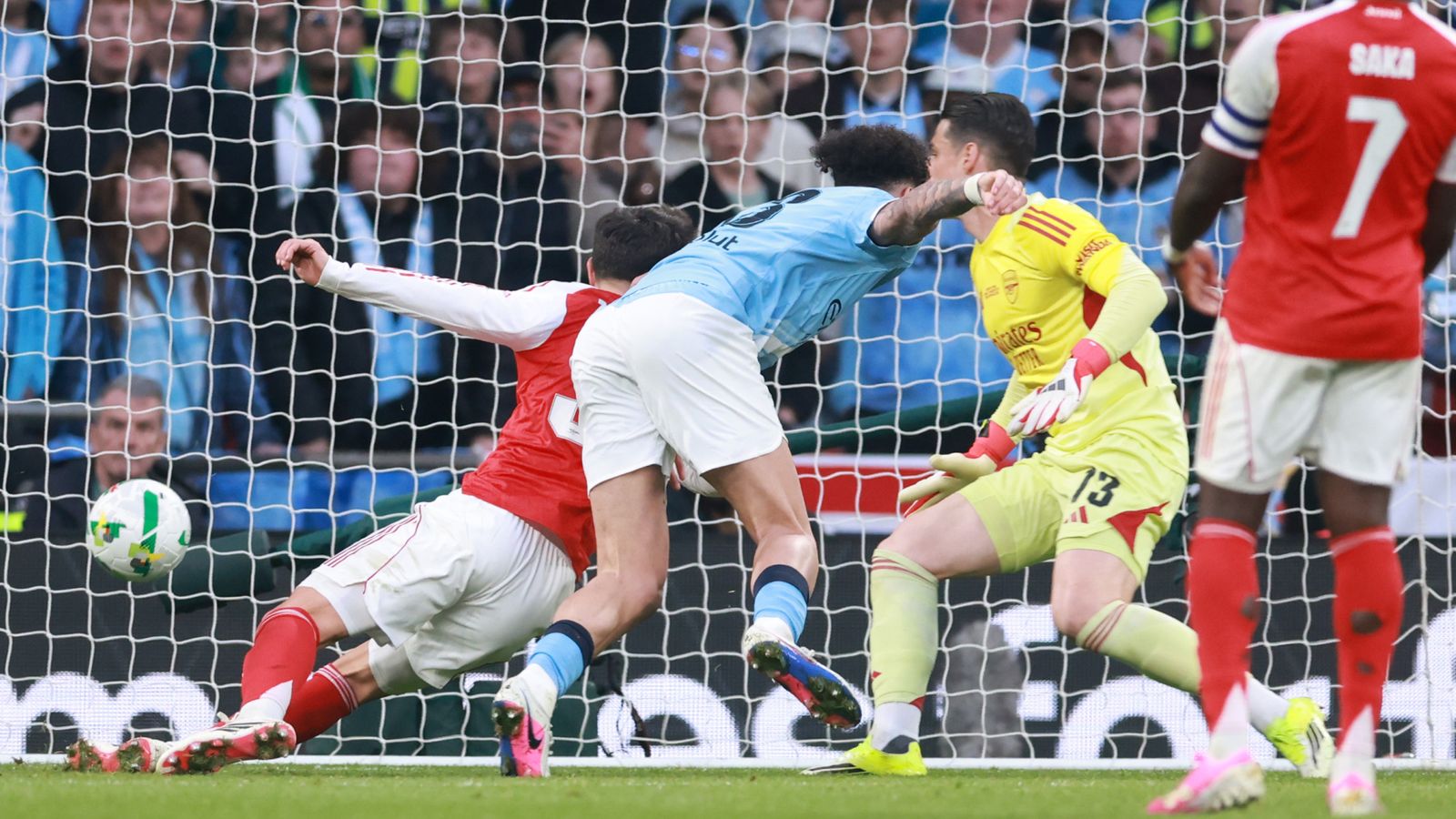
The final whistle at Wembley brought the inevitable divergence in body language. You either stare at the fire or you walk away from it. As the Mirror reported from the pitch, Declan Rice turned his back while Gabriel Magalhaes forced himself to watch Manchester City lift the Carabao Cup.
It is a classic sports media narrative. We pretend that watching your rivals celebrate provides some magical fuel for the remainder of the season. It does not.
What matters is not the post-match reaction, but the 90 minutes that preceded it. Arsenal did not lose at Wembley because they lacked desire. They lost because their pressing triggers failed to solve Pep Guardiola's latest build-up structure.
With two months left in the Premier League season, that tactical failure is a massive red flag. Arsenal have closed the gap, but the gap still exists. And it exists primarily in the center of the pitch.
The Rodri dilemma
Mikel Arteta has built a phenomenal out-of-possession machine. Arsenal's 4-4-2 mid-block is usually the most suffocating structure in European football. Martin Odegaard and Kai Havertz split the opposition center-backs, while the wingers jump on the full-backs.
City broke it within ten minutes.
Guardiola instructed John Stones to step alongside Rodri, but slightly offset. It was not a flat double pivot. Stones sat five yards higher. When Odegaard pressed Ruben Dias, Dias simply clipped the ball into that exact pocket of space.
Rice was caught in two minds. If he jumped to Stones, Kevin De Bruyne was completely isolated behind him. If he stayed on De Bruyne, Stones had time to turn and ping diagonals to Phil Foden.
This is the problem with playing City in high-stakes matches. You prepare for their shape from Tuesday, and they arrive on Sunday playing a mutated 3-1-5-1 in possession. Arsenal spent the first half chasing shadows. They registered a miserable 0.14 xG before the interval.
You cannot win titles if you spend 45 minutes of a cup final trying to figure out who is supposed to mark the inverted center-back.
Saka isolated and nullified
The knock-on effect of City controlling the middle was severe. Arsenal rely heavily on their right-side dynamics. Ben White overlaps, Odegaard dictates, and Bukayo Saka isolates his full-back.
At Wembley, Josko Gvardiol gave Saka absolutely nothing. But Gvardiol had help.
Because City kept the ball so effectively, Arsenal's average defensive line dropped deeper. When they did win it back, Saka was receiving the ball 60 yards from goal instead of 30. He was immediately doubled by Gvardiol and Mateo Kovacic.
White could not overlap because he was pinned back by Jeremy Doku's high positioning. It was a tactical checkmate on that flank.
Arteta needed to shift the point of attack to Gabriel Martinelli on the left. But Arsenal's left-side progression is still fundamentally broken. Jakub Kiwior is a solid defender, but he lacks the passing range of Oleksandr Zinchenko. Without that inverted presence, Martinelli was starved of service.
This is a glaring flaw in Arsenal's squad construction. If the Saka-Odegaard axis is jammed, the whole machine sputters.
The Premier League run-in
We are entering the final sprint of the Premier League season. The narrative says Arsenal are battle-hardened and ready to avenge last year's collapse. The tactical reality is far less romantic.
Arsenal still struggle against teams that can successfully bypass their first line of pressure. When forced to defend in a low block for extended periods, they eventually crack. William Saliba and Gabriel are elite, but they cannot defend an entire half of the pitch indefinitely.
Look at the remaining fixtures. Arsenal have to go away to Tottenham and Manchester United. Both of those teams, despite their respective flaws, have the transition speed to exploit Arsenal if the initial press fails.
City, meanwhile, are shifting into their terrifying spring gear. Erling Haaland is making his trademark near-post runs. Foden is operating at a world-class level in the half-spaces.
- City have superior depth in central midfield.
- Guardiola has more tactical variations to unlock deep blocks.
- Arsenal are over-reliant on Saka's individual brilliance to break deadlocks.
The verdict
Do not let the proximity of the points total fool you. Manchester City operate on a different tactical plane when the pressure ramps up.
Arsenal are a fantastic football team. They have the best defense in the league on paper. But they are rigid. They have a Plan A that works 85% of the time. When it doesn't, Arteta is too slow to adjust his midfield configuration.
Guardiola will tweak his build-up shape three times in a single half to find an advantage. That flexibility is worth points over a 38-game season.
My prediction is simple. Arsenal will drop points away from home in the next month. City will grind out a 12-game unbeaten run.
The title is staying in Manchester. City will win it by at least four points. The Wembley defeat was not a bump in the road for Arsenal; it was a mirror reflecting their tactical limitations.
Read Next
- Manchester City exposed Arsenal’s lack of depth in a clinical cup masterclass
- Top 10: The defining moments of the 2025/26 domestic season
- Arsenal need a response against City or the season risks sliding away
- Arsenal's Wembley failure exposes Arteta's biggest tactical blind spot
- 🏆 FA Cup Final 2026 — May 16, Wembley
- ⭐ UCL 2026 — Champions League Quarter-Finals Hub