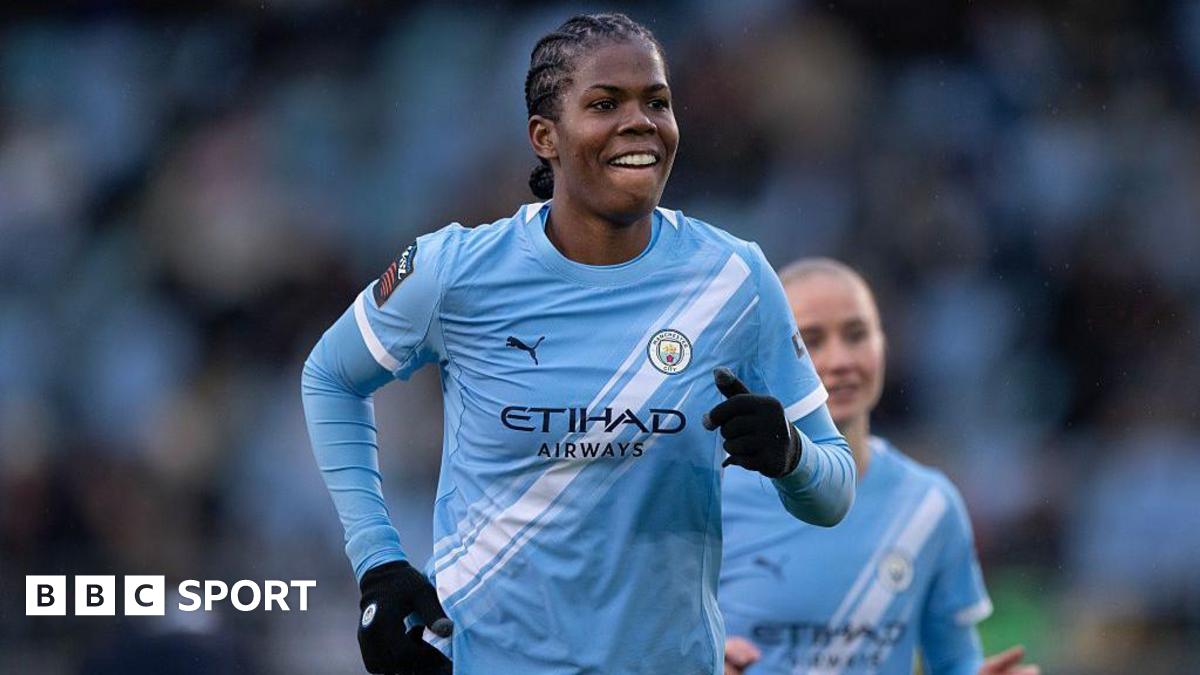
The mathematical certainty of Khadija Shaw
Khadija 'Bunny' Shaw finished the 2025/26 WSL season with 21 goals in 22 appearances. It is a figure that demands attention not just for the volume, but for the ruthless efficiency behind it. When Manchester City lifted their first league title in a decade this past week, the statistical profile of their talismanic forward provided the clear explanation for their narrow margin over Chelsea.
Shaw averaged 1.14 non-penalty goals per 90 minutes this term. To put that in perspective, no other player in the top flight cleared the 0.85 mark. She isn't just leading the league; she is operating in a different statistical stratosphere, turning half-chances into high-percentage outcomes through sheer physical dominance and elite movement in the six-yard box.
According to Sky Sports, Shaw has delivered a cryptic message regarding her future at the Joie Stadium. For Gareth Taylor, the numbers suggest that losing her would be more than a personnel change; it would be a total system failure. City's entire tactical blueprint is built around Shaw’s ability to occupy two central defenders simultaneously.
The mechanics of a 21-goal season
Analyze Shaw's shot map and a pattern emerges. She does not waste energy on speculative long-range efforts. Over 88 percent of her total shots this season came from inside the penalty area. She is the ultimate predatory finisher, a player who understands that in the high-stakes environment of a title race, shot quality trifts shot volume every single time.
Her conversion rate of 26.4 percent is the highest of any forward with more than 50 attempts in the league. While rivals like Lauren James or Alessia Russo often drift wide to find the ball, Shaw remains disciplined in the 'gold zone' between the goalposts. This positional rigidity allows wingers Lauren Hemp and Mary Fowler to fire in crosses with the certainty that their target will be exactly where the data dictates.
Shaw’s aerial dominance remains her most potent weapon. She won 4.2 aerial duels per match this season, a success rate of 62 percent. In a league where most center-backs struggle with back-post crosses, Shaw has weaponized the height advantage that City’s system provides. Six of her 21 goals this season were headers, all resulting from second-phase play where she out-muscled her marker.
The critical weakness in City's dependency
There is, however, a dark side to these glowing metrics. Manchester City have become dangerously one-dimensional. Shaw accounted for 44 percent of the team's total league goals this season. When she was substituted or marked out of a game, the drop-off in City’s xG was instantaneous and severe. In the three matches where Shaw failed to record a shot on target, City only managed a single goal.
This over-reliance was most visible in the late-season draw against Arsenal. The Gunners effectively triple-marked Shaw, daring City's midfielders to find another route to goal. They couldn't. Jill Roord and Yui Hasegawa looked lost without their focal point, recycling possession in harmless areas because they lacked the confidence to pull the trigger themselves. If Shaw departs this summer, Taylor is left with a squad that has forgotten how to score collectively.
The physical toll is also starting to show in the data. Shaw's sprint distance per 90 has declined by 12 percent over the last 18 months. She is becoming a more stationary target man, trading mobility for power. While this has worked in the WSL, it raises questions about her longevity if she moves to a more transition-heavy league like the NWSL or even Liga F, where defenders are quicker to recover.
The cost of replacement
If the cryptic comments reported by Sky Sports translate into a transfer request, City face a financial and tactical nightmare. Replacing a player with a 0.98 xG per game output is virtually impossible in the current market. You don't just buy those numbers; you have to rebuild the entire supply chain that produces them. Without Shaw, the high-volume crossing of Hemp becomes a strategy without a payoff.
Market valuations for forwards of Shaw's caliber have shifted dramatically. A replacement would likely cost upwards of £450,000, a record-breaking fee that still wouldn't guarantee the same level of domestic familiarity. The gamble for City is whether they can diversify their scoring enough to survive her exit, or if they must break their wage structure to keep her in Manchester.
The reality is that City won this title on the back of one player's historic efficiency. They averaged 2.6 points per game when Shaw started, compared to just 1.4 when she was absent from the lineup. Those are the numbers of a championship-defining talent. Losing her now, just as the club finally found its footing at the top of the table, would be a regression they cannot afford before the 2026 World Cup cycle kicks into high gear.
The final verdict on the Shaw era
Shaw’s impact is best measured by the fear she instills in opposition benches. Managers have spent the last eight months designing 'Shaw-stoppers'—tactical tweaks specifically aimed at neutralizing her 18-yard box presence. Most failed. Even when teams knew exactly where the ball was going, they lacked the physical tools to stop her from connecting with it.
We are watching a peak-level athlete maximize every facet of her game. Shaw has refined her touch, improved her link-up play, and become a leader in the locker room. But the statistical reality remains: she is the engine, the fuel, and the driver of this Manchester City team. Without her, they are just another ball-retention side with no final product.
Whether she stays or goes, the 2025/26 season will be remembered as the year Khadija Shaw broke the WSL. She didn't just win a title; she proved that in a game obsessed with complex tactics, a world-class #9 is still the most valuable asset in football. City fans better hope those cryptic messages are just a negotiation tactic, because the alternative is a return to the trophyless wilderness.