The Mathematics of Disciplinary Chaos
Refereeing at the highest levels of football occasionally breaks down into simple arithmetic failures. We all remember Graham Poll at the 2006 World Cup in Germany, flourishing a yellow card at Croatia's Josip Šimunić three separate times before finally producing a red card. It remains the gold standard for officiating meltdowns, a moment where the basic mechanics of the sport temporarily short-circuited.
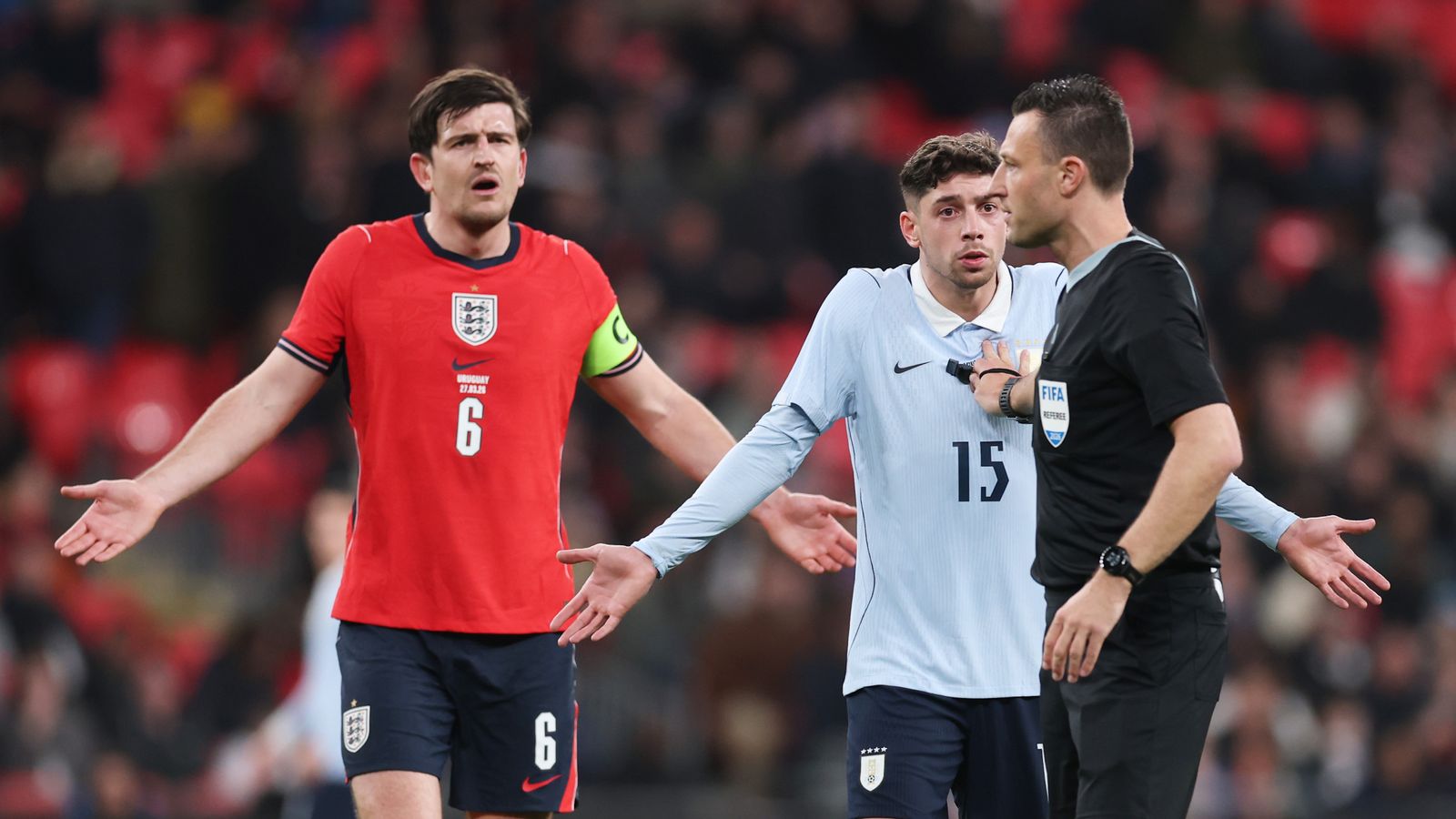
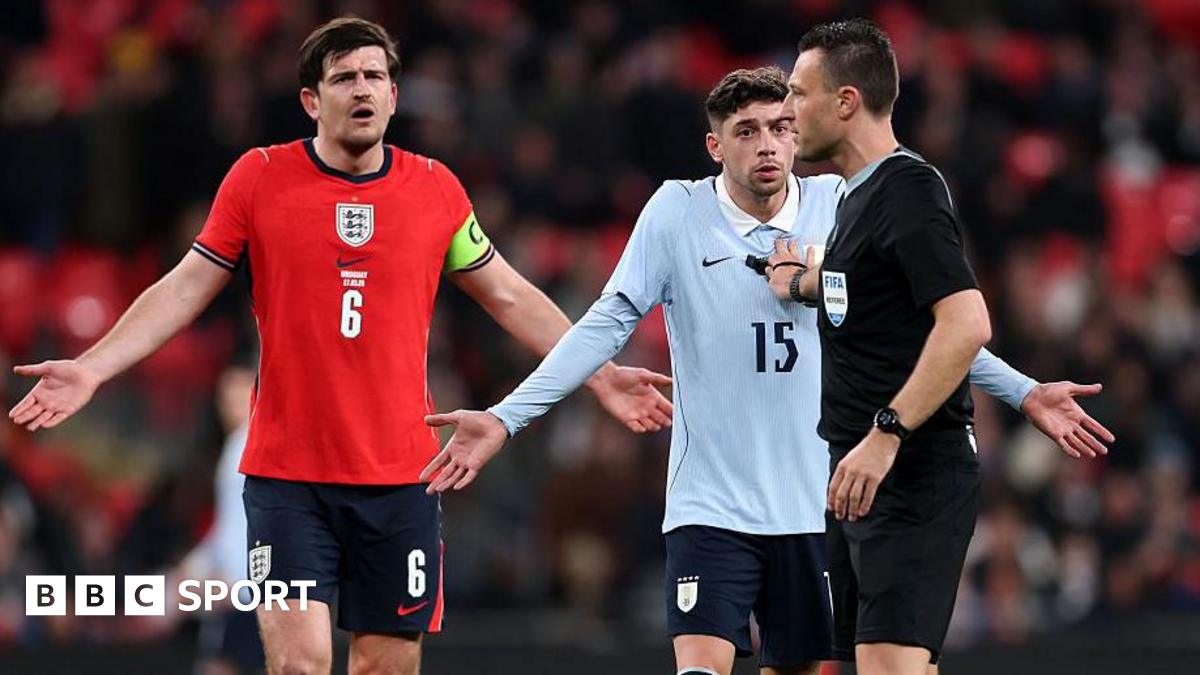
Fast forward two decades to the current international break, sitting exactly 75 days before the 2026 World Cup kicks off. England hosted Uruguay in a fixture explicitly designed to test tactical setups, not refereeing protocols. Yet, Manchester United midfielder Manuel Ugarte managed to pull off the rarest of footballing feats: receiving two yellow cards in the same match without being sent off.
According to reports from the Mirror, Ugarte looked certain to receive his marching orders. Instead, he was granted a bizarre reprieve. In the strange, loosely regulated environment of international friendlies, the normal laws of gravity do not always apply. But beyond the novelty of the refereeing quirk, the incident highlights something fundamental about Ugarte's game. He simply does not know how to play exhibition football.
The Friendly Loophole and Exhibition Mechanics
To understand how a player survives two bookings, you have to look closely at the mechanics of exhibition matches. Friendlies exist in a bizarre regulatory twilight zone. While FIFA officially sanctions them for ranking purposes, the participating national associations often agree to bespoke, unwritten rules to ensure the fixture serves its primary tactical purpose.
Teams routinely agree to up to six substitutions rather than the standard five. In some advanced tactical tests, managers pre-arrange protocols for red cards to prevent a game from descending into a useless attack-versus-defence exercise. If a player commits a second bookable offence, the referee—often under instruction from the fourth official—might allow the team to substitute the offender rather than reducing them to ten men.
This is a purely pragmatic solution. Managers like Gareth Southgate and Marcelo Bielsa do not learn anything useful about their defensive structures by playing an uneven match for forty-five minutes. But it creates a jarring viewing experience for match-going fans who expect the fundamental laws of the sport to hold firm. It feels like a glitch in the simulation.
More importantly, it provides a fascinating lens into Ugarte's playing style. That he managed to accumulate two bookable offences in an exhibition match tells you exactly who he is as a footballer. He does not possess an off switch. Whether it is a high-stakes Premier League derby or a meaningless kickabout under the arch at Wembley, his defensive metrics remain violently consistent.
Profiling the Destroyer: A Statistical Breakdown
Ugarte's disciplinary record is not an anomaly; it is the absolute foundation of his game. Since arriving in Europe, the Uruguayan has built a statistical profile that leans heavily on disruption, aggression, and calculated risk. He is a pure volume tackler in an era where most teams prefer positional containment.
During his breakout season at Sporting CP, Ugarte posted absurd defensive numbers. He averaged 4.6 tackles per 90 minutes, placing him comfortably in the 99th percentile among midfielders across Europe's top five leagues. He wasn't just attempting tackles in his own defensive third; he was actively dismantling opposition transitions before they could cross the halfway line, registering over two ball recoveries in the attacking half per game.
But that sheer volume of engagement comes with a mathematical tax. When you contest that many ground duels—often lunging in from a trailing position—your foul count inevitably rises. Ugarte consistently averages between 2.1 and 2.5 fouls per 90 minutes. He treats yellow cards not as severe warnings, but as an acceptable operating expense. For Manchester United, this has been a frustrating double-edged sword. They desperately needed his ball-winning capacity to plug the gaping holes in their midfield transition defence, but his aggressive positioning often leaves him walking a dangerous disciplinary tightrope.
Against England, we saw the rawest, most unfiltered version of this profile. In a match where most elite players subconsciously dial down their physical intensity by ten percent to protect their hamstrings ahead of the club run-in, Ugarte was still flying into challenges. The first yellow card was likely a product of his standard aggressive pressing triggers. The second was the inevitable result of his refusal to adjust his tempo once booked.
The True Value of Expected Threat (xT) Prevention
There is a distinct, measurable difference between reckless fouls and tactical necessities. The best defensive midfielders in the world—players like Rodri or prime Fabinho—mastered the dark art of the cynical foul. They look at the pitch through the lens of Expected Threat (xT). They know exactly when to drag a shirt or trip a runner to prevent a transition that carries a high probability of resulting in a shot.
Ugarte is still refining this vital aspect of his game. A deep dive into his statistical footprint reveals a player who occasionally fouls in low-danger areas. Committing a foul in the attacking third to stop a quick goalkeeper release is smart, analytical football. Picking up a booking for a late lunge near the touchline when the defence is already set behind the ball is a massive failure of game state awareness.
This is the central flaw in his current evolution at Old Trafford. His defensive actions map shows a heavy concentration of tackles in the middle third, which is excellent for sustaining pressure. But his foul map is erratic and scattered. He does not always choose his moments wisely. His foul-to-tackle ratio is consistently higher than the elite standard of 0.5 fouls per tackle, indicating that he is often a fraction of a second late to the duel.
When partnered with Kobbie Mainoo, who relies on spatial intelligence rather than brute force, Ugarte's tendency to vacate his zone to chase a tackle can disrupt Manchester United's entire defensive shape. If he misses the tackle and commits the foul, the pressure is temporarily relieved. But if the referee plays an advantage, the backline is instantly exposed to a direct numerical overload.
For a team like Uruguay, who play a high-octane, physically demanding man-to-man system under Bielsa, that relentless aggression is explicitly encouraged. Bielsa accepts the fouls as a byproduct of the high press. But in the structured, unforgiving environment of the Premier League, where referees are increasingly stringent on repetitive fouling, it frequently leaves his club vulnerable during the final twenty minutes of tight matches.
Preparing for the Expanded Tournament Grind
The bizarre double-yellow incident against England might be a forgotten footnote in the grand scheme of the domestic season, but it highlights a much broader tactical issue for Uruguay as they prepare for the summer. The 2026 World Cup features a bloated, physically demanding 48-team format. To reach the latter stages and lift the trophy, teams will have to navigate a gruelling, extended schedule.
Squad depth and rigorous disciplinary management will be paramount. A player like Ugarte, who is statistically guaranteed to pick up cards at a high frequency, becomes a structural liability in a knockout tournament format where suspensions kick in rapidly. If he continues to accumulate yellows at his current domestic and international rate, he risks missing defining quarter-final or semi-final fixtures when the tactical margins are at their absolute tightest.
Uruguay simply cannot afford to lose their primary engine room enforcer because he failed to calibrate his tackling radius in a comfortable group stage victory. The friendly reprieve he received at Wembley against England won't be available when the actual tournament begins on June 11.
Ultimately, the strange double-yellow anomaly is a perfect, compressed microcosm of Manuel Ugarte as a footballer. It takes a relentless, bordering on reckless, commitment to your defensive principles to get booked twice in a meaningless international friendly. Manchester United and Uruguay both benefit enormously from his chaotic ball-winning energy. But as the stakes rise and the margin for error inevitably shrinks, the cold mathematics of his aggression will need to mature.