The Hidden Cost of Chaos
The final whistle at the Parc Des Princes confirmed a 5-4 victory for Paris Saint-Germain over Bayern Munich. Fans and pundits immediately labeled it a Champions League classic. For the medical staffs of both clubs, it was an absolute nightmare.
A nine-goal football match does not happen through controlled possession. It happens through chaos, broken tactical structures, and relentless end-to-end transitions. That translates directly to an unplanned spike in high-intensity sprints.
While no immediate muscle tears or structural injuries were reported in the flash interviews, the physical damage is already done. When a game turns into a track meet, sports scientists watch their load management data turn completely red.
The immediate aftermath of a match like this isn't just about ice baths. It is about assessing acute central nervous system fatigue and severe glycogen depletion before the adrenaline even wears off.
The Dembele Tightrope
Ousmane Dembele walked off the pitch with two goals and the tie tilted in PSG's favor. From a medical perspective, his performance was a massive gamble. The French winger has a notoriously fragile physical history.
During his years at Barcelona, maximal velocity efforts frequently resulted in hamstring ruptures. Scoring twice in a high-stakes semi-final demands absolute peak acceleration. Every time he dropped his shoulder and exploded past a Bayern defender, the medical staff held their breath.
Managing Dembele through a 90-minute frantic shootout is a massive risk. He survived Tuesday night, but the delayed onset muscle soreness peaking at 48 hours post-match will be severe. The micro-tears in his hamstring fibers will need aggressive recovery protocols.
There is a harsh reality here regarding tactical discipline. PSG's inability to control the tempo forced their most injury-prone attacker into repeated, exhaustive sprints just to keep them in the tie.
Kvaratskhelia's Explosive Output
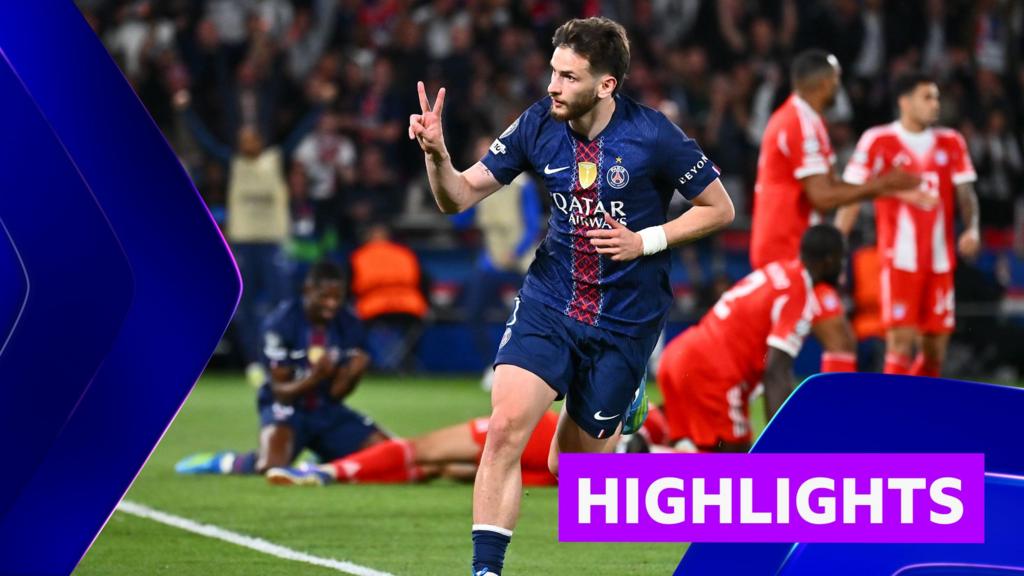
Khvicha Kvaratskhelia matched Dembele with two goals of his own. The Georgian international plays a different style of winger, heavily reliant on sharp deceleration and lateral changes of direction. This places immense, repeated stress on the patellar tendon and the meniscus.
In a structured game, Kvaratskhelia might attempt five or six isolated one-on-one take-ons. In a 5-4 shootout, he was forced into continuous isolation battles in wide areas. The biomechanical load on his knees during those sharp cuts is staggering.
We have seen this exact scenario play out before. When players exceed their usual threshold for directional changes in a single match, the joint inflammation often sidelines them for the subsequent domestic fixture. Kvaratskhelia is young, but human tissue has mechanical limits.
The Midfield Burnout
While the goalscorers grab the headlines, the central midfielders bore the brunt of the physiological trauma. When a match produces nine goals, it means the midfield shape has completely disintegrated. Holding midfielders are forced into repetitive, desperate recovery runs over 40-yard distances.
Every time Bayern lost the ball, their double pivot had to sprint backwards at maximal exertion to cover Dembele and Kvaratskhelia. These are not steady, aerobic jogs. They are anaerobic bursts that flood the legs with lactic acid and tear at the gluteus medius.
We saw this exact breakdown in real-time. By the 75th minute, the distance between the defensive lines stretched to unmanageable levels. Players were running on fumes, completely masking their exhaustion with adrenaline.
Tracking data from similar wide-open European ties shows midfielders covering over 13 kilometers, with more than 1,500 meters clocked at sprint speeds above 25 kilometers per hour. That kind of isolated distance is a direct fast-track to a torn groin or a strained calf muscle.
Historical Precedent and the Recovery Clock
Recent Champions League history offers a grim warning for both squads. Consider the 2022 semi-final between Manchester City and Real Madrid, which ended 4-3 in the first leg. The physical hangover from that match was profound.
Players from both City and Madrid reported extreme fatigue, and several missed their weekend league matches with minor strains. A similarly chaotic tie occurred in 2017 when Monaco beat City 5-3. The lack of midfield control in these games forces defenders and attackers into unrecoverable sprint distances.
PSG and Bayern now face a brutal turnaround. The second leg is scheduled for May 5, 2026. That gives the medical teams exactly six days to repair exhausted muscles.
The recovery timeline is rigid. Wednesday is purely about flush-out exercises and sleep therapy. Thursday will feature heavy soft tissue work and cryotherapy. Neither squad will do any meaningful tactical work on the grass until Friday afternoon.
By the time Sunday arrives, the physical trainers will have to make hard decisions. Anyone showing elevated creatine kinase levels—a marker of muscle damage—will have to be pulled from training. You cannot cheat the biological healing process.
The Looming World Cup Risk
There is an elephant in the room regarding this fixture. We are staring down the barrel of the 2026 FIFA World Cup, which kicks off on June 11. That is exactly 43 days away.
International managers watching this 5-4 spectacle were likely sick to their stomachs. Didier Deschamps and Willy Sagnol watched their star attackers push their bodies to the absolute limit. The muscular overload from April and May Champions League fixtures is the primary cause of group-stage injuries in summer tournaments.
National team doctors are essentially powerless right now. They can send warning memos to club medical staffs, but a Champions League semi-final supersedes any international caution. If a player feels a slight tightness in his hamstring during a Sunday morning walkthrough, he will take painkillers and play anyway.
That short-term thinking routinely ruins summer tournaments. We lose star players to completely preventable soft-tissue injuries simply because nobody is willing to hit the brakes. The bodies on the pitch at the Parc Des Princes were flashing warning lights for a solid 45 minutes.
UEFA and FIFA continue to pack the calendar without regard for human physiology. The sheer volume of matches means players are already operating on a fitness deficit. Forcing them into a chaotic, high-transition semi-final right before a massive international tournament is reckless.
Both PSG and Bayern will likely field heavily rotated, weakened squads in their domestic leagues this weekend. They have no choice. If Dembele or Kvaratskhelia play meaningful minutes on Saturday, they risk a complete muscular breakdown before Tuesday's return leg.
The Parc Des Princes delivered a classic for the television audience. But behind the scenes, the medical teams are scrambling to prevent a physical collapse. The real cost of this nine-goal thriller will be paid over the next six days.
Read Next
- PSG and Bayern just broke the Champions League and nobody is complaining
- Khvicha Kvaratskhelia is the ghost that still haunts Leeds United's boardroom
- Where Bayern and PSG would actually finish in the Premier League
- Top 10 Champions League Semi-Final Moments: Where the PSG-Bayern Thriller Ranks
- 🏆 World Cup 2026 — Full Coverage Hub
- ⚽ Ligue 1 2025-26 — PSG, Monaco & the Title Race Hub
- ⭐ UCL 2026 — Champions League Quarter-Finals Hub