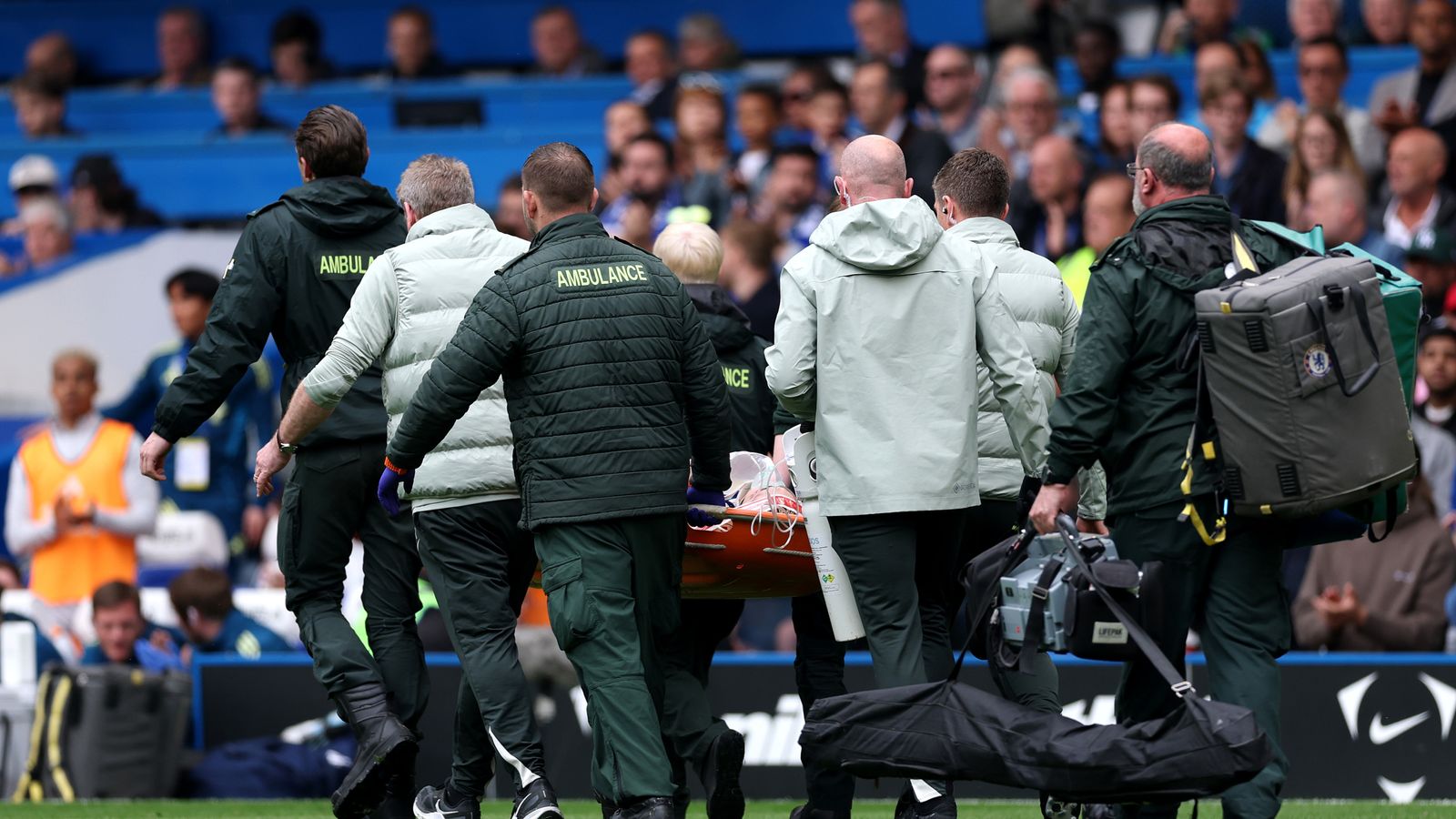
Immediate Evacuation from the City Ground
The stark reality of Premier League football hit 18-year-old Jesse Derry on Monday night. During Chelsea's frustrating defeat to Nottingham Forest, the teenage forward sustained a head injury severe enough to warrant immediate removal from the pitch and a subsequent trip to a local hospital.
The medical staff at the City Ground did not hesitate. In an era where head trauma is rightfully treated with zero tolerance, the decision to transfer Derry was classed as precautionary. But in the context of professional football medical protocols, a "precaution" involving a hospital transfer indicates a collision that crossed the threshold for immediate, advanced neurological assessment.
This was not a minor knock. It was a violent introduction to the senior game's uncompromising physicality.
The Medical Protocol Now in Play
When a player is removed under these circumstances, the immediate pitch-side assessment is only phase one. The hospital visit triggers a comprehensive diagnostic process.
Medical staff will have immediately sought to rule out structural damage. A CT scan is standard operating procedure for significant head impacts to check for skull fractures or intracranial bleeding. Assuming those worst-case scenarios are cleared, the focus shifts entirely to concussion management.
If a concussion is confirmed, Derry enters the FA's mandated Return to Play protocol. This is not a system that can be rushed. The clock stops.
The baseline stand-down period dictates that a player cannot even begin the graduated return to training until they have been completely symptom-free for a specified duration. For a teenager, medical departments often err on the side of extreme caution. The developing brain is demonstrably more vulnerable to second-impact syndrome and prolonged post-concussion symptoms.
The Staged Return
Fans expecting a quick bounce-back will be disappointed. The protocol requires Derry to pass through specific physical gateways.
It begins with light aerobic exercise. Only if he remains asymptomatic for 24 hours can he progress to sport-specific movements. From there, it moves to non-contact training drills. The final hurdle is full-contact practice. If symptoms return at any stage, the player drops back to the previous step.
This means Derry is almost certainly ruled out of Chelsea's immediate upcoming fixtures. The medical department at Cobham will take total control of his schedule, completely isolating him from the immediate demands of the first-team coaching staff.
The Psychological Toll on a Debutant
Beyond the clinical mechanics of a head injury, the timing for Derry is brutal. Breaking into the Chelsea first team is one of the most notoriously difficult tasks in European football. The academy produces elite talent, but the pathway is frequently blocked by expensive acquisitions.
Earning minutes in a Premier League fixture is a massive milestone. Having that momentum violently halted by a head injury is a profound psychological blow.
Young players thrive on rhythm and confidence. A severe collision can create hesitancy. The next time Derry contests an aerial duel or attacks a near-post cross, the memory of the Forest game will be present. Rehabilitation in these cases involves rebuilding physical trust in one's own body as much as healing the initial trauma.
The club's sports psychologists will be as crucial over the next month as the medical doctors. They have to ensure that the fear of a repeat injury does not blunt the aggressive, instinctive style that earned Derry his spot in the squad.
Historical Precedents and Changing Attitudes
To understand the gravity of Derry's situation, we have to look at how these incidents were handled a decade ago. Historically, a player in Derry's position might have been given smelling salts, asked a rudimentary question about the scoreline, and pushed back onto the pitch to run it off.
The consequences of that era are currently playing out in tragic detail with former professionals suffering from early-onset dementia and chronic traumatic encephalopathy. The Premier League, under immense pressure from medical professionals and advocacy groups, has been forced to fundamentally alter its approach.
The introduction of permanent concussion substitutes was a direct response to incidents where players visibly struggling were kept in the game. When Derry went down against Forest, the immediate activation of the medical team and the subsequent hospital transfer reflect this new reality. The optics of a teenager struggling with a head injury are something no club, and no league, is willing to risk anymore.
Yet, despite the improved protocols, the core danger remains. Football is inherently a contact sport where heads are used as tools to direct a heavy ball traveling at high speeds, and where two players frequently compete for the same space in the air.
A Broader Industry Failure
This incident forces a recurring conversation back to the surface. Is the step up from academy football to the Premier League simply too vast in terms of pure, brute force?
We routinely see technically gifted 18-year-olds dominated physically by seasoned professionals who are stronger, heavier, and completely uncompromising in challenges. While technical development in England has never been better, the physical disparity remains a massive risk factor.
This is the critical failure point in modern youth integration. Clubs demand instant impact from teenagers, but often throw them into an environment where the physical risks are magnified. The speed of the game in the final third means collisions are harder and the margin for error in avoiding them is practically nonexistent.
The Specific Mechanics of Head Trauma in Football
While the exact nature of Derry's collision hasn't been detailed beyond the initial classification, the mechanics of football concussions follow predictable, dangerous patterns.
Most frequently, it is not ball-to-head contact that causes severe trauma, but head-to-head, head-to-elbow, or head-to-ground impacts. The rotational force applied to the brain inside the skull during these sudden decelerations is what causes the microscopic axonal injury associated with concussions.
For a forward like Derry, operating in tight spaces around the penalty area, the risk is acute. Defenders are trained to clear the ball aggressively. When a young, brave forward attempts to win a header in a congested box, they are exposing themselves to significant blunt force trauma.
The hospital checks are designed to ensure no subdural hematoma has occurred. This is the immediate, life-threatening concern. Once cleared of that, the long, frustrating road of concussion recovery begins.
The Impact on Chelsea's Planning
For Chelsea, the immediate fallout is tactical and rotational. Monday's loss to Forest was already a massive blow to their campaign momentum. Losing a dynamic, young attacking option removes a vital injection of pace and unpredictability from the bench.
The squad is now stretched thinner. The manager will have to rely more heavily on fatigued senior players, a situation that often creates a cascading effect of soft-tissue injuries later in the month.
The Cobham medical room is already under intense scrutiny. The handling of Derry's recovery will be watched closely. There can be no shortcuts. The medical staff must hold the line against any pressure to fast-track his return, prioritizing the long-term neurological health of an 18-year-old over the short-term tactical needs of a struggling squad.
The Waiting Game at Cobham
The next update from Chelsea will likely be brief and heavily sanitized. Expect phrases confirming he is resting at home and following protocols.
What happens behind the scenes will define Derry's immediate future. The daily cognitive tests, the careful monitoring of his sleep patterns, and the slow, isolated physical work.
Derry's immediate schedule will consist of absolute rest. No screens, no loud music, minimal sensory input. The brain requires an environment devoid of stimulation to begin repairing the chemical imbalance caused by the impact. Only when he reports zero symptoms will the Chelsea medical staff even consider moving him to a stationary bike.
This incident serves as a brutal reminder of the physical cost of elite football. For Jesse Derry, the immediate focus shrinks from Premier League glory to passing a basic cognitive baseline test. The club must now protect him, not just from the opposition, but from his own likely desire to return to the pitch before his brain is truly ready.