The scoreline says perfection but the reality was a circus act
Germany just put up a 7-1 scoreline against Curacao to kick off their World Cup campaign, and if you just checked the box score, you’d assume Julian Nagelsmann has finally built a machine that runs like a high-end German roadster. Don’t get it twisted. While the attacking output was clinical, the fifteen minutes surrounding the half-hour mark were a complete car crash, the likes of which would give any self-respecting Bundesliga fan a seizure.
Kai Havertz looked sharp, which is a terrifying thought for any defender drawn into his orbit. But if we are being honest, watching Jonathan Tah and Antonio Rudiger scramble to cover space against Curacao’s counter-attacking setup felt like watching two guys trying to hold back a leaking dam with nothing but rolls of duct tape and prayers. The organization was nonexistent for long stretches.
Nagelsmann operates on the principle that the scoreboard acts as its own anesthetic. If you score four, you can afford to concede two, as long as the fans are entertained. It is a philosophy that works against C-tier international squads, but it is the kind of hubris that gets exposed immediately once the real heavyweights show up in the knockouts. You cannot play with the structural discipline of a primary school recess game in the quarter-finals.
The Irankunda sparkle in a desert of caution
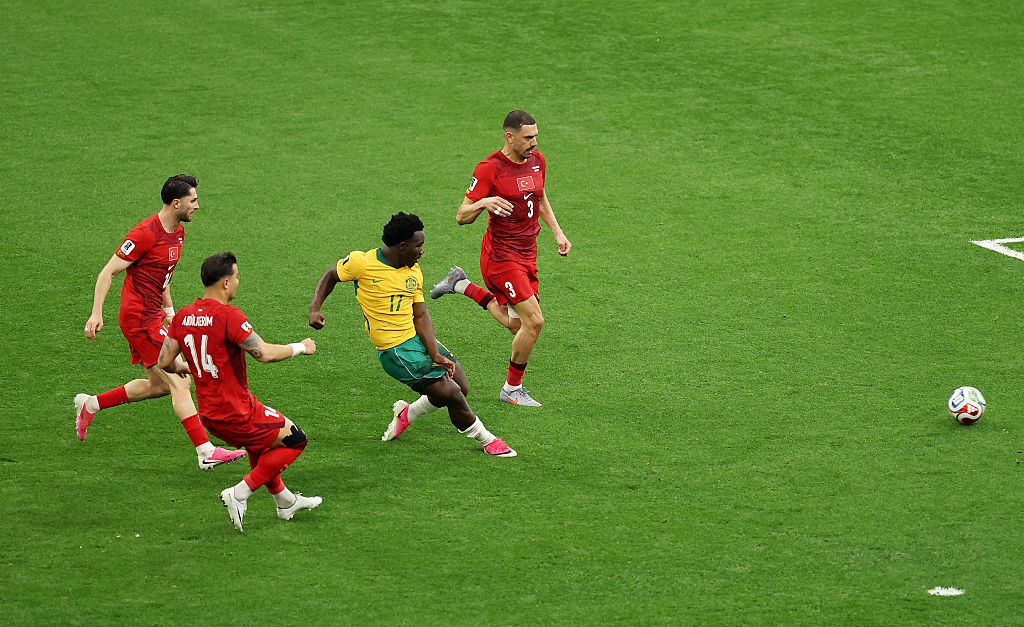
If you were watching the Australia-Turkey match, your eyes probably took a moment to recalibrate after Nestory Irankunda stepped onto the pitch. We have spent an eternity talking about the tactical rigidity of international football, but the kid decided to opt for chaos instead. That wonder strike wasn't just a goal; it was a middle finger to the consultants who want to drain the joy out of the sport.
Irankunda represents the exact kind of raw, unpolished kinetic energy that Germany was trying to curate a decade ago before they got obsessed with possession metrics. Seeing that kind of talent is a reminder that football, at its heart, is about moments. It is about a 19-year-old deciding that the 25-yard line is close enough to launch a rocket. We need more of that and less of the horizontal passing drills that define modern international buildup play.
Still, look at the contrast. Germany beats Curacao by six goals and we feel obligated to talk about the 'ruthless efficiency' of the squad. But the efficiency is a facade. Behind the curtain, there is a distinct lack of cohesion in the midfield transition that Curacao actually managed to exploit twice before they collapsed completely under the weight of their own fatigue. If you are struggling to maintain a defensive shape against an island nation with a population smaller than a decent-sized suburb in Hamburg, you are not ready for the knockout stages.
The Nagelsmann contradiction
Nagelsmann is coaching this team like he is trying to win a FIFA simulation on legendary mode. He wants the high press, the aggressive overlap, and the constant goal-scoring threat. But football is not a video game where you can just toggle the aggression slider to max without consequence. The space left behind the fullbacks yesterday wasn't just a gap; it was an open freeway for anyone wearing a Curacao jersey who had the legs to run.
Maybe this is the price of the new era. Defensive solidity is becoming an archaic concept, sacrificed at the altar of high-scoring thrillers designed to keep the broadcasters happy. But as much as I appreciate the spectacle, there is a part of me that misses the days when a clean sheet actually meant something. When Julian Nagelsmann talks about 'making a statement,' I hope he realizes that the other teams watching are not intimidated by the seven goals.
They are looking at the defensive holes and licking their chops. If the goal was a statement, it was one that said: 'We dare you to attack us, because we might just forget to defend.' That is a dangerous game to play, even if it makes for incredible television. As recent reports highlighted, the squad's adaptation to this hyper-offensive system remains a massive point of contention among the local pundits who remember the 2014 era.
Reality checks and broken dreams
There is a specific danger in over-analyzing a blowout win. It masks the rot. When your attacking players are this talented, they paper over the cracks of an unproven backline. Havertz, Musiala, and Wirtz can carry you past the minnows, but they cannot defend your own box when you are pinned against a superior counter-attacking side. If Germany continues to treat every match like an exhibition of their own offensive prowess, the inevitable exit will not be a surprise.
It will be a result of coaching stubbornness. Nagelsmann has to decide if he wants to win a tournament or just win the crowd. Right now, he is firmly in the latter camp, prioritizing highlight-reel moments over the kind of gritty, boring, disciplined football that actually hoists trophies at the end of the month. Whether this 7-1 result is the ceiling or the floor for this team is the big question hanging over the camp.
Historically, Germany thrives when they have a balance between the artistic flair of their forward line and a wall in the midfield. Right now, that wall is missing. The midfield is porous and reliant on the defenders having the games of their lives every single night. Unless they find a way to plug those gaps, they are one high-pressing opponent away from a humiliating exit that will make this 7-1 win look like a cruel joke.
Football is about the marriage of talent and discipline. Until Germany decides that conceding is actually a bad thing, they are an exciting watch, but they aren't champions. We are all waiting to see if they can grow up when the pressure actually hits. Until then, grab the popcorn and hope your favorite defender isn't the one caught out of position.
Read Next
- Germany’s 7-1 demolition of Curacao was a fever dream of defensive chaos
- Klopp and Nagelsmann clash as World Cup punditry sparks Germany tension
- Germany just got embarrassed by a country the size of a gas station
- Germany’s Houston clinic exposes the gaps in the Curacao dream
- 🇩🇪 Germany World Cup 2026 — Die Mannschaft Hub