
Ireland's tactical cowardice in Prague was always going to end in tears
The Anatomy of a Self-Inflicted Wound
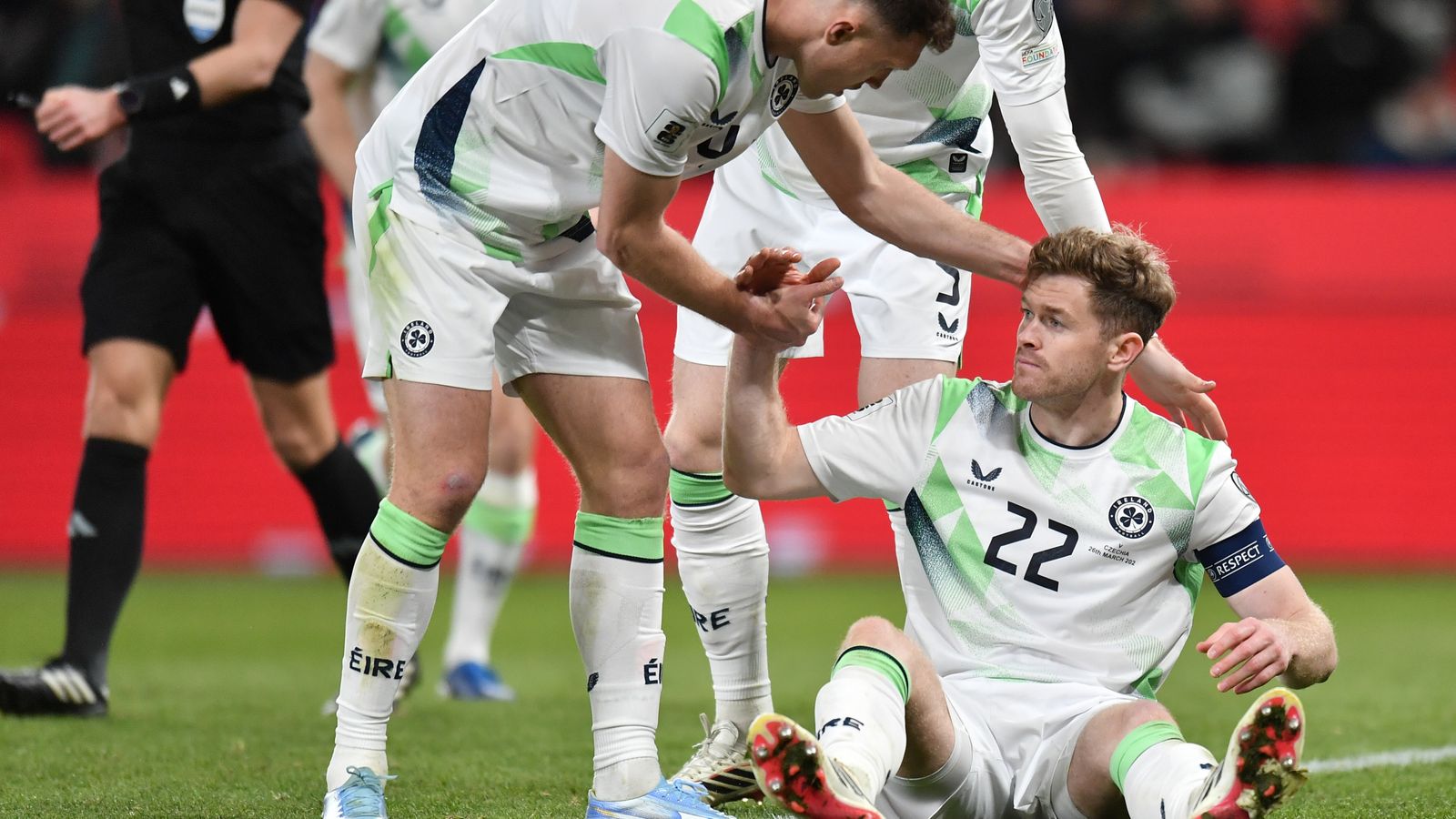
Prague on a Wednesday night in late March is usually a city of quiet beauty, but the Generali Arena felt like a cold, industrial furnace for 120 minutes. Ireland arrived with a singular, grim purpose: to stifle, to bore, and to survive. They succeeded in the first two, but the third was always a gamble that the gods of the penalty spot rarely reward. Missing out on the expanded 48-team World Cup is not just a disappointment; it is a structural failure of imagination from a side that had the tools to actually play football.
For the entire first half, Ireland operated in a 5-4-1 that frequently collapsed into a 6-3-1. Nathan Collins and Dara O'Shea were essentially playing as auxiliary full-backs, pinned back by the constant lateral movement of Tomas Soucek. The Czech captain didn't even need to touch the ball to destroy Ireland's shape. He simply occupied the space between the lines, forcing Josh Cullen to drop deeper and deeper until Evan Ferguson was left as a solitary island 40 yards away from his nearest teammate.
It was a performance that lacked any tactical proactive trigger. When you play a low block, you need a release valve. Ireland didn't have one. They had a bunker. Every time a clearance was hoisted toward Ferguson, he was swarmed by David Zima and Ladislav Krejci. Without any runners from midfield to disrupt the Czech rest-defense, the ball came back at the Irish goal like a recurring nightmare. As Sky Sports reported, the heartbreak was real, but the inevitability of it was visible from the 12th minute.
The Illusion of Defensive Solidity
Statistics often lie, but the xG battle in Prague told a brutal truth. Ireland finished the match with a cumulative 0.18 expected goals. That is not a typo. Over two hours of high-stakes international football, a team with Premier League strikers and Bundesliga-tested midfielders managed to create less than a fifth of a goal's worth of chances. They were playing for the lottery of penalties from the opening whistle. It was a strategy built on the hope that Caoimhin Kelleher could perform another miracle.
Kelleher was indeed magnificent, making three saves in normal time that he had no right to make. One fingertip stop from a Patrik Schick header at the back post was world-class. But relying on your goalkeeper to bail out a lack of offensive structure is a recipe for disaster. The Irish midfield was a desert. Will Smallbone tried to find pockets of space, but he was constantly tracked by Lukas Provod, who bullied the Irish playmaker out of the game. Smallbone’s pass completion rate dropped to a dismal 64% by the time he was substituted.
The lack of variety in Ireland's build-up was staggering. Every goal kick was aimed at the same five-square-yard patch of grass on the right flank. The Czechs figured this out within twenty minutes. They started cheating their defensive line toward that side, knowing Ireland wouldn't dare switch the play through the middle. It was predictable, stale, and ultimately, cowardly. A team with this much technical talent shouldn't be terrified of the ball.
The Cruelty of the Spot
Penalties are often described as a lottery, but that’s a convenient myth for managers who fail to prepare. The shootout in Prague was a masterclass in psychological pressure versus technical execution. Ireland started well, but as the rounds progressed, the fatigue of defending for 120 minutes began to show. You could see it in the heavy legs of the takers. When the ball is at the spot and the World Cup is on the line, the exhaustion of chasing shadows for two hours manifests in the smallest of muscle twinges.
The Czech Republic took their penalties with a clinical, almost robotic efficiency. They went high and hard. Kelleher guessed right twice but couldn't reach shots that were tucked into the top corners. Ireland, conversely, looked hesitant. The miss that will haunt the flight back to Dublin came from a senior player who tried to be too clever, attempting a stutter-step that the Czech keeper didn't bite on. It was a microcosm of the entire match: an attempt to out-think the opposition that only resulted in tripping over their own feet.
The final score in the shootout, 4-3, looks close on paper, but it masks the gulf in quality that existed throughout the evening. The Czechs looked like a team that knew they would eventually win. Ireland looked like a team that was just waiting for the moment they would lose. That shift in mentality is the hardest thing to coach, and right now, the Irish camp feels devoid of that killer instinct. They have become experts at the 'gallant loss,' a category of performance that provides no points and no plane tickets to North America.
A Generation Stalled
This was supposed to be the tournament where the 'Golden Generation' of Irish youth finally arrived. Instead, they will be watching from home. Evan Ferguson is 21 years old and is already carrying the weight of a nation’s expectations, but he cannot do it alone. He spent the night in Prague wrestling with center-backs and receiving passes that were essentially just hopeful punts. If Ireland continues to play this brand of reactive football, they are going to waste the best years of the most talented striker they have produced since Robbie Keane.
The tactical setup didn't just fail Ferguson; it failed the wing-backs. Festy Ebosele has the pace to burn most defenders in Europe, yet he was instructed to stay behind the halfway line for the majority of the match. On the few occasions he was allowed to venture forward, he looked dangerous, but the leash was always pulled tight. It felt like watching a Ferrari being used for a school run in a 20mph zone. It was a waste of resources that should be a sackable offense.
There is also the question of the substitutions. Waiting until the 104th minute to introduce more attacking impetus was a baffling decision. The Czechs were tiring, the game was stretched, and Ireland had fresh legs on the bench that could have exploited the gaps. Instead, the management opted for defensive reinforcements, clearly banking on the shootout. It was a decision rooted in fear rather than ambition. Real progress in international football comes from taking the game to the opposition when they are vulnerable, not huddling in a circle and praying for a whistle.
The Long Shadow of 2026
The fallout from this defeat will be significant. The FAI has gambled heavily on World Cup qualification to balance the books, and missing out on the 2026 expansion is a financial blow as much as a sporting one. More importantly, it breaks the momentum of a project that was supposed to be about 'playing the right way.' If the 'right way' ends in a 5-4-1 stalemate and a penalty exit against a beatable Czech side, then what exactly is the goal? Ireland have moved from being a team that was hard to beat to a team that is just hard to watch.
There has to be a critical look at the coaching staff's inability to adapt mid-game. When the Czechs brought on Mojmir Chytil to partner Schick, the Irish shape didn't change. They simply let themselves be pushed further back. There was no attempt to bypass the Czech press or to use the half-spaces. It was a rigid, dogmatic adherence to a failing plan. In modern football, if you don't evolve over the course of 90 minutes, you are already dead. Ireland were a corpse walking for the last hour of that match.
As we look toward the summer, the realization will sink in that Ireland won't be part of the biggest party in football history. The 2026 World Cup was the perfect opportunity for this squad to test themselves against the world's best. Instead, they are stuck in the cycle of 'what ifs' and 'if onlys.' The heartbreak in Prague wasn't a fluke of the penalty spot; it was the logical conclusion of a tactical philosophy that prioritizes not losing over trying to win. Until that changes, the results never will.
Read Next
adidas FIFA World Cup 2026 Trionda Competition Soccer Ball
The official match-day feel for the 2026 North American tournament.
More Coverage
Scotland’s path through group stage hinges on the Haiti opener
58 minutes ago
Lamine Yamal's fitness status sparks panic for Spain before World Cup 2026
an hour ago
Manchester United are chasing ghosts with the Leao pursuit
2 hours ago
Why England must fear Panama's disciplined low block
3 hours ago
Arsenal vs PSG: Why tactical rigidity will determine the European champion
4 hours agoLincoln City just entered the weirdest experiment in League One history
6 hours agoMore Analysis
Ireland's exit proves that playing for penalties is a loser's game
2 months agoIreland find a new way to break hearts in Prague
2 months ago
Ireland's World Cup dream just died in a Prague penalty shootout
2 months ago
Ireland's World Cup dream dies in the most Irish way possible
2 months agoIreland are crumbling under Czech pressure and this playoff is only going one way
2 months ago