
Michael Carrick's chaotic United finish third by accident
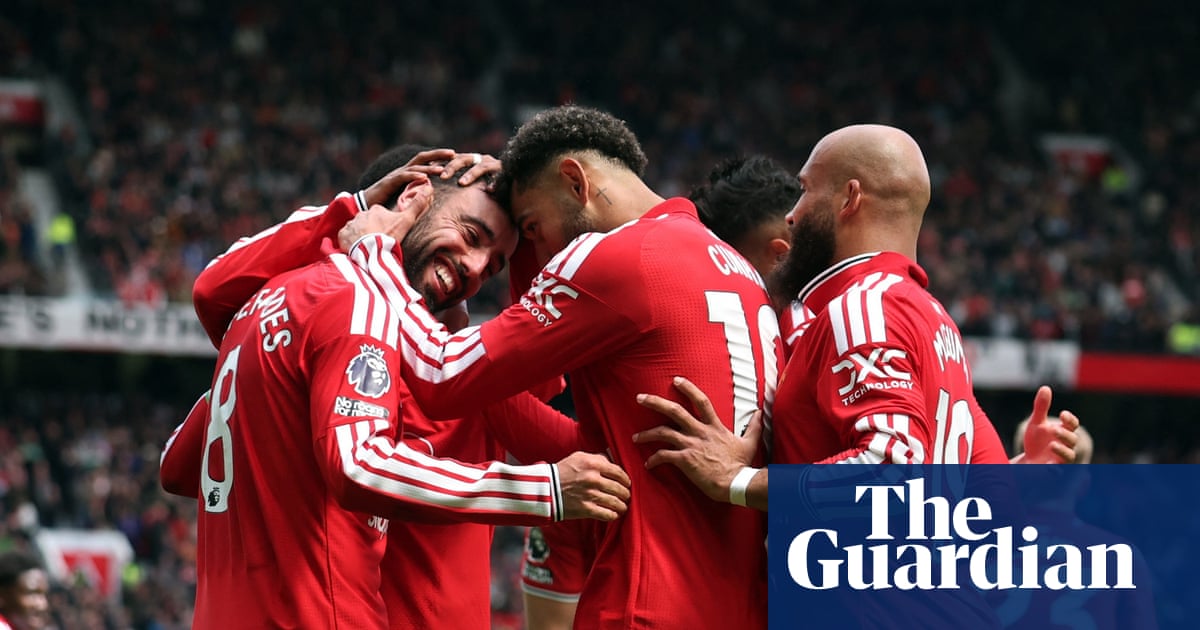
A Marriage of Convenience Turns Triumphant
Manchester United have finished third. If you look purely at the league table on this Sunday, May 17, 2026, you might assume a steady, progressive campaign at Old Trafford. You might imagine a squad clicking into gear, executing a modern tactical blueprint, and sweeping aside mid-table opposition with ruthless efficiency.
You would be completely wrong.
The reality of Manchester United’s season, and specifically their frantic 3-2 victory over Nottingham Forest to secure that third-place finish, is far stranger. This is not a team moving with synchronized precision. This is a collection of expensive individuals operating on instinct.
They are bailed out repeatedly by moments of sheer individual brilliance and baffling refereeing decisions. As The Guardian reported, this is the new era of 'happy accidents' under Michael Carrick. It is a terrifyingly fragile way to play football, yet it has somehow carried them to a podium finish.
The Stand-in Manager
We have to rewind five months to understand the context of this bizarre achievement. When Michael Carrick was handed the reins, it was not the culmination of a rigorous recruitment process. The club had simply run out of obvious options.
The managerial market was barren, the dressing room was fractured, and the board needed a familiar face to stop the bleeding. Carrick was a stopgap. A temporary fix to see out a doomed campaign.
Yet, he has navigated the team to third. He deserves immense credit for his pragmatism. He recognized immediately that this squad was incapable of executing complex pressing traps or dominating possession in the final third.
Instead, he stripped the instructions back to the absolute minimum. He asked his defensive line to sit deeper, invited pressure, and relied entirely on his forwards to figure it out in transition.
It is anti-system football. It is the tactical equivalent of throwing a handful of darts at the board and hoping two of them hit the treble twenty. Against Nottingham Forest, we saw the exact limitations of this approach.
United struggled to string five passes together in the opposition half during the opening forty-five minutes. There was no concerted effort to manipulate Forest’s block. The midfield was merely a transit zone, a space the ball bypassed as quickly as possible on its way to the front three.
When you watch elite teams in 2026, you see automated passing circuits. You see players arriving in zones because they know exactly where their teammates will be. Under Carrick, United players look like strangers meeting for a Sunday league fixture.
They rely on eye contact, pointing, and individual improvisation. It is ugly, disjointed, and entirely reliant on variance falling in your favor.
The Nottingham Forest Battle
Forest arrived at Old Trafford knowing exactly how to exploit this structural void. They did not sit back in a terrified low block. They recognized that United’s midfield lacked press resistance, so they pushed their lines up and engaged aggressively in the middle third.
They were a genuinely battling side, snapping into tackles and forcing turnovers in dangerous areas. For large stretches of the match, the away side looked vastly superior in their organization. When Forest lost the ball, they had immediate counter-pressing triggers.
Two men would instantly converge on the United player in possession, suffocating the transition before it could begin. When United lost the ball, they simply retreated into a desperate defensive shell, dropping ten yards deeper and inviting wave after wave of pressure.
Forest isolated United’s full-backs, created overloads in the wide channels, and generated high-quality chances. They consistently found the spare man in the half-spaces, exploiting the massive gaps between United's midfield pivot and their back four.
This was not a case of a plucky underdog holding on against a relentless giant. This was a mid-table side systematically dismantling a Champions League-bound team's buildup phase. United were hanging on, relying on last-ditch tackles and rushed clearances.
The 3-2 scoreline flatters the hosts immensely. The underlying flow of the game suggested a comfortable away victory was on the cards until the officials decided to intervene.
The VAR Farce
The game pivoted entirely on an incident in the 55th minute. With the match poised and Forest applying heavy pressure, Matheus Cunha found the back of the net to make it 2-1 to Manchester United.
To call the goal controversial is to aggressively understate the situation. It was a sequence that defied logic, common sense, and seemingly the laws of the game. While I will not dissect every individual foul missed in the buildup, the sheer confusion on the pitch was staggering.
Forest players stopped playing, expecting a whistle that never came. The VAR review process seemed to drag on indefinitely, searching for a reason to justify a decision that appeared fundamentally flawed in real time.
The reaction on the television broadcast captured the mood perfectly. As Sky Sports showed, Gary Neville was left utterly bemused by the referee awarding the goal, exclaiming:
"Oh my goodness, WOW!"
That is the only appropriate response. Confusing officiating directly altered the trajectory of the match. Forest’s momentum was instantly killed.
You could see the belief drain from the away side. They had executed their game plan perfectly, only to be undone by a catastrophic failure in the officiating process.
United did not out-tactic Forest to gain the lead. They were simply handed it. This has been a deeply worrying trend over the last five months.
Carrick's happy accidents often seem to involve a whistle blowing at exactly the right time, or failing to blow at all. You cannot build a football club's future on the unpredictable incompetence of Premier League referees. Forest were legitimately robbed of a foothold in a game they were largely dominating.
The 20-Assist Anomaly
We then move to the 76th minute, the moment that officially cemented Bruno Fernandes in the history books. His delicate cross was finished perfectly by Bryan Mbeumo, making the score 3-1 and killing the game entirely.
That assist was his twentieth of the Premier League campaign. He has equaled the all-time single-season record, placing him alongside Thierry Henry and Kevin De Bruyne. It is a monumental achievement that demands respect.
But we need to talk about how he achieved this, because his methodology is entirely alien to the men he shares the record with. Henry accumulated his numbers as a roaming forward in an Arsenal side playing fluid, devastating attacking football. De Bruyne reached the milestone as the primary creative node in Pep Guardiola’s hyper-structured positional play machine.
Every run, every angle, every pass was calibrated. Fernandes operates in chaos. He is a high-volume, high-variance creator playing in a team with no discernible attacking structure.
He hits twenty assists because he attempts passes that no sensible midfielder would even consider. He will lose the ball ten times attempting impossible through-balls, but the eleventh will split a defense perfectly.
His assist to Mbeumo was a prime example of this dynamic working flawlessly. Mbeumo, making his trademark blindside run from the right channel, spotted a momentary lapse in the Forest defensive line. Fernandes found a tiny pocket of space in the right half-space, ignored the simple retention pass, and whipped a vicious, dipping cross.
Mbeumo barely had to break stride to delicately finish it. You cannot argue with his output. He is a statistical phenomenon.
But building a team around a player who surrenders possession this frequently is a tactical tightrope walk. It works when you finish third, but it is precisely why United cannot control big football matches. They are constantly reacting to the chaos their own captain creates.
When Fernandes drops deep to get on the ball, he empties the number ten space. When he drifts wide, he isolates the striker. It is a one-man show masquerading as a tactical system.
The Illusion of Progress
So where does Manchester United go from here? The board will undoubtedly look at the league table and feel vindicated. They will look at the twenty assists registered by Fernandes and assume the attack is functioning.
They will point to the points accumulated since Carrick took over and claim the crisis is averted. This is a dangerous illusion. Third place is a fantastic outcome, but the process underlying it is entirely unsustainable.
You cannot go into a new season relying on a defensive block that sits too deep, a midfield that cannot retain possession under pressure, and an attack that requires historic statistical anomalies just to function.
Carrick has done a remarkable job stabilizing a sinking ship. He deserves his flowers for keeping his head down and grinding out results when the club was in freefall five months ago. He stopped the dressing room leaks, he benched the underperformers, and he squeezed every drop of transitional threat out of players like Mbeumo and Cunha.
But this cannot be the blueprint for August. If United continue to play this brand of transition-heavy, variance-reliant football, the happy accidents will eventually dry up. Opponents will learn to punish Fernandes' turnovers more ruthlessly.
The baffling refereeing decisions will eventually balance out. When the luck runs out, the lack of a modern tactical framework will be exposed instantly.
They won today against Nottingham Forest, but they played like a team hoping for a miracle rather than executing a plan. The summer window must be about installing a system, not just buying more individuals to throw into the chaos.
Read Next
- Bruno Fernandes hits 20 assists as Man United stumble into third place
- Bruno hit 20 assists but VAR's absolute disaster class stole the show
- United are gambling on Michael Carrick while Rashford looks for the exit
- Michael Carrick is officially the safest, most uninspired hire for Man Utd
- 🇵🇹 Portugal World Cup 2026 — A Seleção Hub
Manchester City FC Official Jacquard Scarf
The essential piece of fan gear for showing your City pride.
More Coverage

Anthony Gordon to Barcelona marks a high-stakes gamble
12 minutes ago
Arsenal vs PSG: Why tactical rigidity will determine the European champion
12 minutes ago
Arsenal's 104 million gamble on Julian Alvarez is pure chaos
12 minutes ago
Top 10: The Definitive Arsenal Moments of the 2025/26 Season
an hour agoLincoln City just entered the weirdest experiment in League One history
2 hours ago
Newcastle are burning the furniture to keep the house warm
2 hours agoMore Analysis

Manchester United’s Chaotic Transition Season
1 week, 4 days agoBruno hit 20 assists but VAR's absolute disaster class stole the show
1 week, 5 days ago
Michael Carrick's Manchester United are stuck in a loop of beautiful chaos
2 months, 1 week ago
Michael Carrick is forcing Manchester United's hand
3 weeks, 4 days ago
Michael Carrick's United frustrations reveal a team still stuck in neutral
2 months, 1 week ago