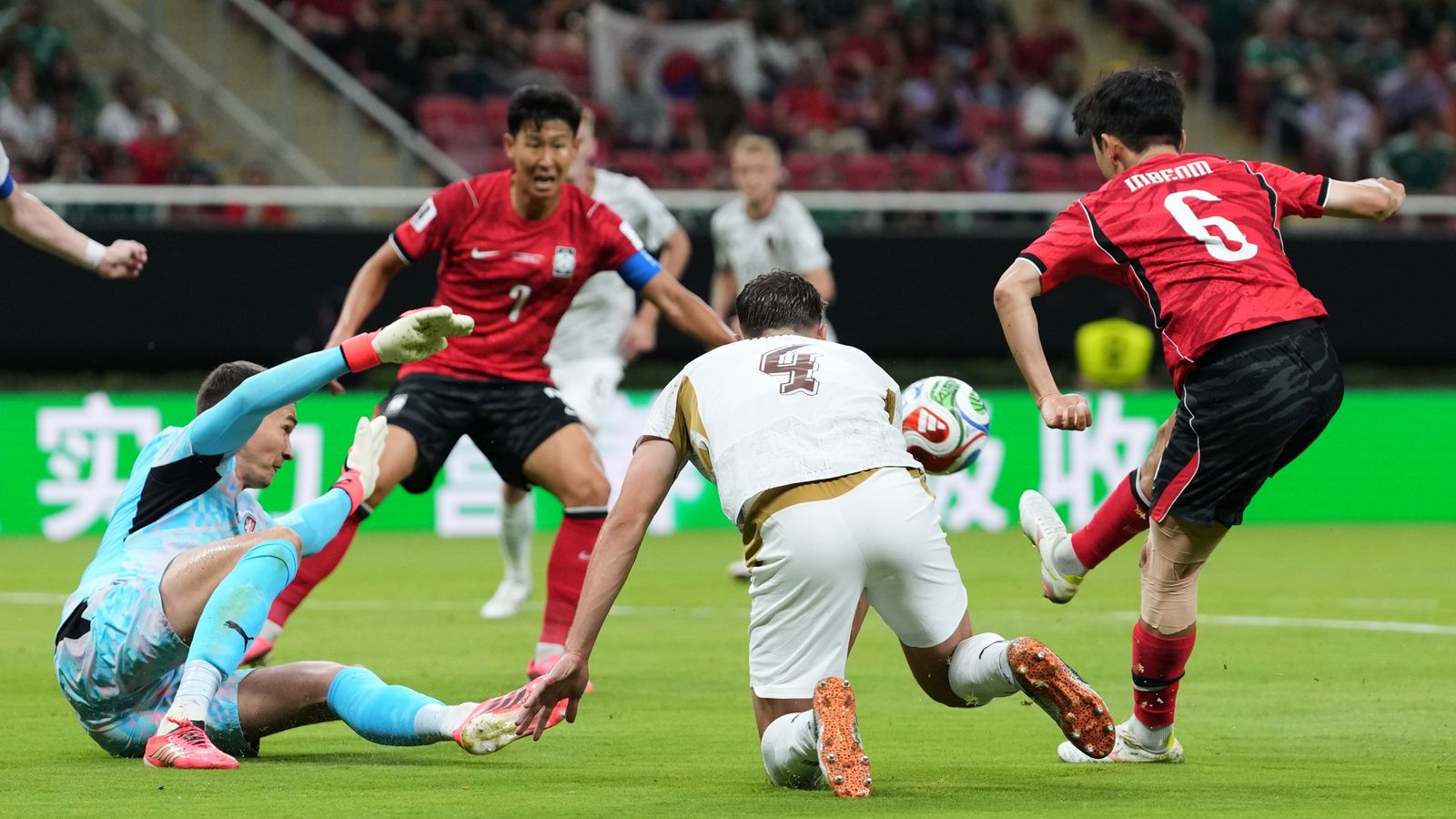
Tactical imbalance in Seoul
South Korea’s 2-1 victory over the Czech Republic serves as a laboratory study on the efficiency of vertical transition play. The statistics from the match confirm a clear disparity in how the two sides utilized possession. While the Czech Republic controlled 56 percent of the ball, they managed only 0.84 xG across 90 minutes. This discrepancy highlights a failure to convert horizontal ball movement into high-probability scoring zones.
The Czech defensive line operated with an aggressive high press, but the spacing between the back four and the midfield pivot was compromised repeatedly. By the 34th minute, South Korea had already completed 14 progressive passes into the final third. These passes originated predominantly from deep-lying midfielders exploiting the space left behind by the attacking-minded Czech fullbacks.
The cost of poor defensive structure
The first goal for South Korea in the 22nd minute was a direct consequence of this structural vulnerability. The Czech midfield lost possession cheaply in the center circle, allowing for a swift vertical entry. With only two defenders back, the transition speed was too high to manage. South Korea effectively bypassed the entire second and third lines of the opposition formation in one sequence.
Shot map data confirms the inefficiency of the Czech attack. They attempted 16 shots, yet only 4 were on target. Contrast this with South Korea, who produced 9 total shots with 5 on target, delivering a conversion rate of 22.2 percent. The reliance on low-probability shots from distance became the defining trait of the Czech offense as the match progressed.
Midfield duels and spacing
Possession metrics are often misleading without context, as reported during the live coverage. The Czech Republic attempted 480 passes, but their completion rate dropped to 74 percent when moving the ball into the final 20 meters. This suggests a disconnect between the build-up phase and the final pass.
South Korea adjusted their defensive block as the match drifted into the final 15 minutes. They dropped into a compact 4-4-2, forcing the Czechs to play wide. Once the ball reached the flanks, the absence of overlapping runs meant the offense became entirely one-dimensional. The Czech squad was relegated to hopeful crosses, resulting in just 2 successful dribbles inside the box for the entire second half.
The failure of the press
Pressing triggers should be the cornerstone of a high-possession team, yet the Czech Republic lacked intensity in their recovery runs. When South Korea recovered the ball in the 58th minute, the recovery time for the Czech midfield was roughly 6 seconds. Modern elite standards require that phase to be completed in under 4.
This defensive lapse allowed South Korea to control the tempo while under pressure. The final shot count was 16-9 in favor of the visitors, yet the quality of those shots remained skewed. South Korea’s ability to maximize their opportunities suggests a level of tactical discipline that their opponents lacked.
Ultimately, the result was decided by individual errors rather than a total breakdown. The Czech Republic failed to capitalize on their 56 percent possession share, proving that without vertical intent, control is meaningless. South Korea left the pitch having shown that tactical efficiency outweighs volume of play.
Read Next
- South Korea’s comeback win over Czech Republic has everyone losing their minds
- South Korea just put the world on notice and the Czechs are reeling
- South Korea vs Czechia will expose the Group A defensive ceiling
- Iran’s World Cup opener is more a security operation than a football match
- 🇰🇷 South Korea World Cup 2026 — Taeguk Warriors Hub