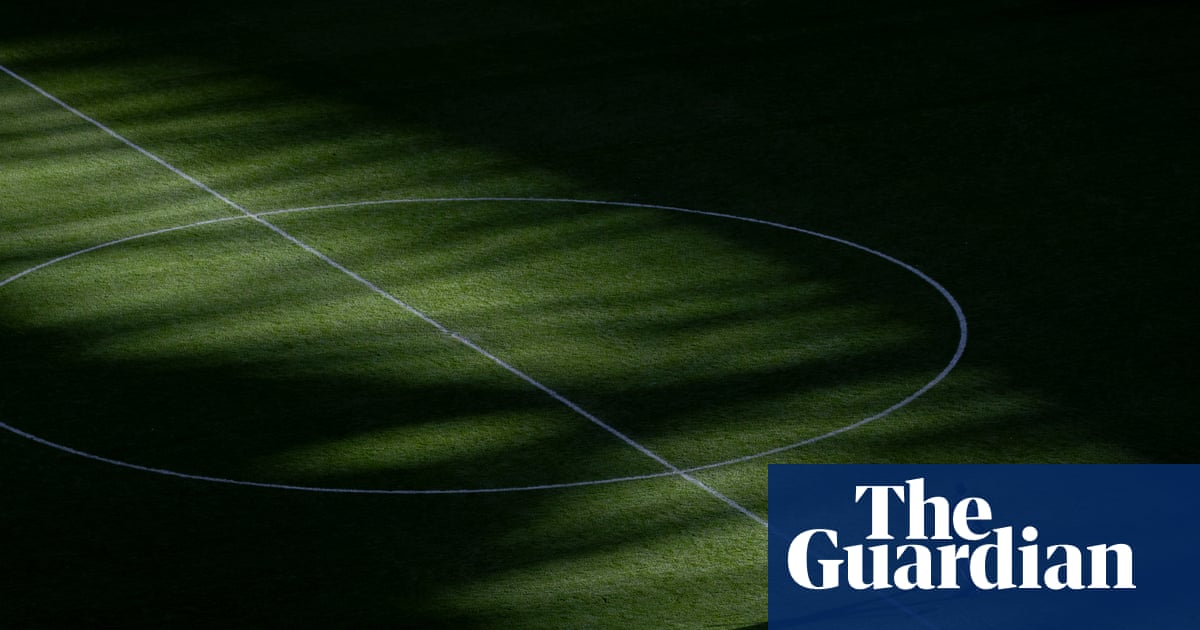
It takes precisely 7,140 sq metres of grass to host a professional football match at Wembley Stadium. That number might seem like a simple geographical fact, but to a modern tactical setup, it represents the exact canvas where passing patterns live or die. The ground staff do not just cut grass. They engineer a surface friction coefficient.
According to a recent piece in The Guardian, Wembley head groundsman Karl Standley and his assistant Cameron Hutcheon approach this task with obsessive perfectionism. They are preparing for a weekend that features two consecutive games. That is a brutal workload for a modern pitch, and the implications stretch far beyond aesthetics.
Fans often ignore the surface until a player slips on live television. But analytical departments at elite clubs spend serious resources modeling pitch behavior. They track ball speed decay across different stadiums to adjust passing weights. The men pushing the mowers are dictating the tempo of the match before a ball is even kicked.
The physics of possession
Elite managers do not demand heavy pre-match watering because it looks nice on camera. A wet pitch actively reduces the friction between the synthetic leather of the ball and the grass blades. This allows ground passes to retain a higher velocity over longer distances.
If the grass is cut at 24mm rather than 28mm, ball roll speed increases dramatically. Over a 30-yard switch of play, that extra speed shaves up to 15% off the travel time. That fraction of a second is the difference between a winger receiving the ball in space and facing an established double-team. It dictates whether a switch of play is an attacking weapon or a tactical trap.
When the ball travels slower, the defending team's block has time to slide across. A slow pitch is a pressing trigger in itself. Elite teams will actively push their defensive line higher if they notice the ball holding up in the grass. They know the receiving player will have to take an extra touch to get the ball out of their feet, which is all a modern pressing unit needs to swarm the receiver.
The data behind the decay
Let's look at the numbers. Analysts tracking pass velocity metrics know that a perfectly prepared pitch allows a driven ground pass to travel at an optimal speed of roughly 45 kilometers per hour. At this speed, a 20-yard pass takes half a second to reach its target.
Now, introduce a pitch that hasn't been watered, or one suffering from surface wear. The friction increases. That same pass drops to 38 kilometers per hour. It now takes over 0.6 seconds to arrive. That tenth of a second is an eternity in elite football, providing an opposition midfielder the time needed to step into the passing lane and make an interception.
This decay in ball speed forces teams to alter their passing networks entirely. Instead of zipping the ball into the feet of a central striker, teams are forced to play wider, safer passes. Tracking data shows that on slower pitches, teams attempt 18% more long balls simply because playing through the center becomes mathematically unviable.
The hybrid revolution
Modern pitches are not just mud and seeds. Wembley utilizes a hybrid system where roughly 20 million artificial fibres are stitched into the ground by massive laser-guided machines. These synthetic threads make up precisely 5% of the surface area, driven 20 centimeters deep into the root zone.
The natural grass roots entwine with these synthetic fibres, creating a reinforced matrix. This prevents the turf from tearing under the massive kinetic force of a professional athlete changing direction at high speed. When a player plants their foot to execute a sharp turn, they generate lateral forces that would rip a traditional soil-and-grass pitch to pieces. The synthetic fibres hold the ground together.
There is a direct statistical correlation between pitch stability and injury rates. Clubs monitor the hardness of a pitch using a Clegg Hammer, which drops a weight onto the turf to measure deceleration. A reading that is too hard means studs fail to penetrate, causing players to skate over the top and hyperextend their knees. If the reading is too soft, the ground gives way completely, resulting in a spike in hamstring strains.
The geometry of the offside trap
Even the visual presentation of the grass serves a tactical purpose. The ground staff mow the pitch in distinct, alternating horizontal bands. These bands are not just there for aesthetic appeal on television broadcasts. They are precise, measured reference points for the players.
A well-drilled defensive line uses those cut lines to maintain their shape. When a high-pressing team pushes up to squeeze the space, the center-backs constantly check their alignment against the grass patterns. It provides a visual anchor to ensure no one is dropping half a yard too deep and playing a striker onside.
The assistant referees rely heavily on these same lines. Judging an offside call in real-time when players are moving in opposite directions at full sprint is incredibly difficult. The horizontal bands give the officials a fixed grid to measure relative positions. A poorly cut pitch introduces a visual distortion that actively leads to incorrect decisions.
The commercial conflict
Here lies the fundamental problem with the national stadium. The Football Association relies on Wembley to generate revenue through non-football events. They host NFL matches, heavyweight boxing bouts, and massive stadium tours. Each of these events inflicts severe trauma on the carefully managed microclimate of the surface.
You cannot drop 5,000 tonnes of staging equipment onto a living, breathing pitch for a week and expect it to bounce back immediately. The sheer weight causes micro-compaction of the soil structure. This compaction ruins the pitch's ability to drain water effectively and alters the firmness of the surface.
It is frankly ridiculous that the showpiece events of the English football calendar are frequently played on a pitch still recovering from a music concert or an American football game. The ground staff perform minor miracles with grow lights to make it look green for the cameras. But the players know the truth the moment their studs hit the turf during the warm-up.
A pitch that has been heavily compacted loses its natural bounce. The ball dies quicker on impact, forcing players to adjust their first touch and dig the ball out of their feet. For teams that rely on intricate, one-touch combinations around the penalty box, a dead pitch is a tactical nightmare. It acts as an unintentional leveller, heavily penalizing the superior technical team.
Looking ahead to the final
We are exactly 19 days away from the FA Cup Final on May 16. The preparation for that match is already underway. Standley, Hutcheon, and their team will monitor moisture levels, soil temperatures, and grass density with the precision of a laboratory experiment.
The tactical battle between the two finalists will command all the media attention in the build-up. Pundits will argue endlessly about defensive lines and midfield pressing traps. But the flawless execution of those tactics depends entirely on the stage they are performed on.
Consider the data from the last five domestic cup finals. Matches played on pristine, heavily watered surfaces consistently feature higher Expected Goals (xG) totals and a 12% increase in penalty box entries. When the pitch is imperfect, the passing completion rate drops by an average of 3.4%, and the games inevitably devolve into attritional, transitional battles.
We often analyze football as if it is played in a vacuum, a purely theoretical exercise drawn out on a tactical whiteboard. It is not. It is a brutally physical contest played on a highly engineered agricultural product. The FA needs to decide what matters more: the tactical integrity of the football, or the rental fee for a monster truck rally.
Read Next
- Chelsea’s structural flaws are about to be exposed by Leeds at Wembley
- Leeds are ready to turn Chelsea’s UCL distraction into a Wembley nightmare
- Rangers' title hopes hinge on solving their tactical paralysis
- Manchester United are sleepwalking into a summer of regret
- 🏆 FA Cup Final 2026 — May 16, Wembley