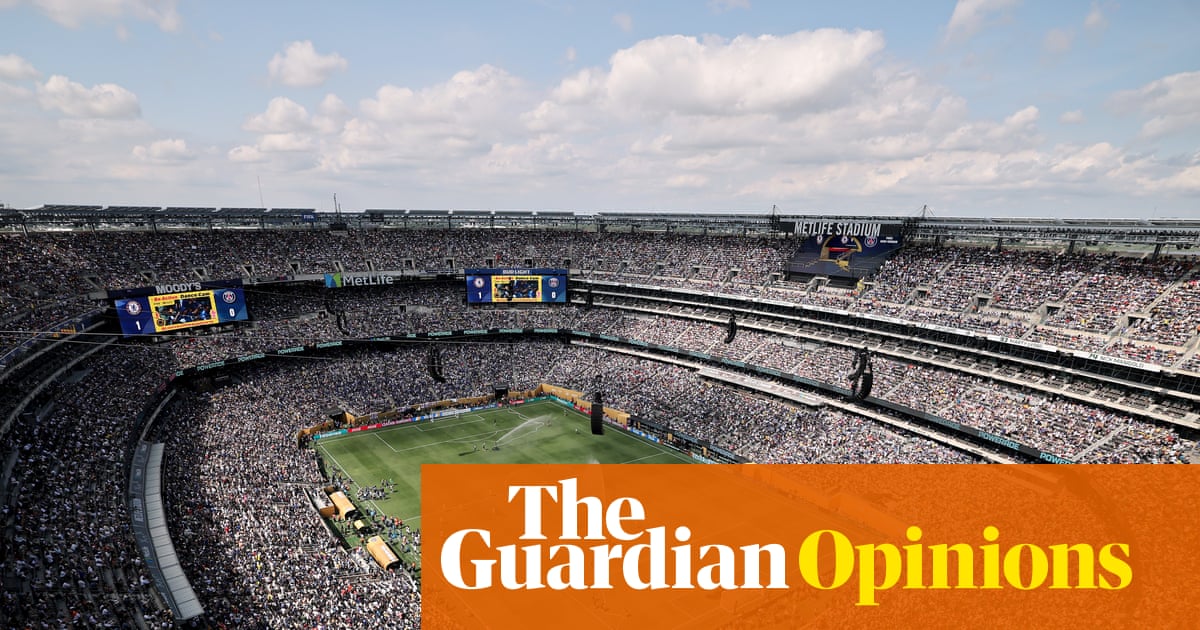
UEFA is finally killing the underdog for a few extra TV dollars
The broccoli of the football season is getting a rebrand
Let’s be honest with ourselves for a second. The international break is the broccoli of the football season. You know it’s technically good for the health of the global game, and you know you’re supposed to care about your country’s coefficient, but nobody actually wants to eat it. You’d much rather be face-down in a double-bacon cheeseburger of a Champions League quarter-final or a high-stakes Premier League relegation scrap.
For years, UEFA has been trying to figure out how to make us stop dreading that two-week void in October where we’re forced to pretend that England vs. San Marino is a legitimate sporting contest. Their first attempt was the Nations League, which was basically a fancy way of saying, We’re tired of friendlies that have the competitive intensity of a Sunday morning yoga class. It worked, mostly because it gave us a reason to care about June. But now, the suits in Nyon are looking at the crown jewel—the European Championship qualifiers—and they’ve decided it’s time for a corporate makeover that would make a McKinsey consultant weep with joy.
The proposal on the table is simple and soul-crushing: turn Euro qualifying into a tiered, Nations League-style system. Instead of the current lottery where France might get stuck in a group with Gibraltar and a bunch of part-time accountants, the big boys will only play the big boys. It sounds great on a PowerPoint slide. It sounds like a dream for the TV networks who are tired of trying to sell advertising slots for games that end 14-0. But in reality, it’s the final nail in the coffin for the romantic, chaotic version of international football we actually fell in love with.
The death of the Cinderella story
The logic behind this shift is that we want more quality. UEFA wants to see Germany play Spain and Italy play England as often as possible because that’s where the money is. They look at a matchup like Portugal vs. Liechtenstein and see a wasted Tuesday night. They want every match to be a blockbuster. It’s the Netflix-ification of the sport—all high-budget originals, no weird local programming.
But here’s the problem: football isn’t a scripted drama. The entire soul of the European Championship is built on the moments where the hierarchy gets punched in the mouth. Remember Iceland in 2016? Remember the sight of a tiny island nation doing the Viking Clap while the English media had a collective meltdown? Under this new proposed system, that probably never happens. If you sequester the smaller nations into their own little 'League D' bubble, you’re essentially creating a closed shop. You’re telling the Luxembourgs and the Georgias of the world that they aren’t invited to the party until they’ve spent a decade winning games in the basement.
The meritocracy myth
UEFA will tell you this is about meritocracy. They’ll say that playing teams of a similar level helps smaller nations develop. That’s a load of absolute nonsense. You don’t get better at football by playing the team that finished 142nd in the FIFA rankings every three months. You get better by standing in the tunnel next to Kylian Mbappe, realizing he’s a human being, and then trying to tackle him into the third row of the stands. That experience is vital for the growth of smaller federations. It’s how you build a culture. It’s how you get kids in Tbilisi or Reykjavik to pick up a ball instead of a game controller.
"If we move to a system where the elite only face the elite, we are essentially turning the European Championships into a private members' club with a very expensive velvet rope."
By removing the chance for a giant-killing in the qualifying rounds, you’re stripping away the primary reason people watch these games. We watch because we want to see the upset. We watch because we want to see the 16 teams that shouldn't be there suddenly find a way to make it. If I know that Italy and France are guaranteed to play each other four times a year in various tiered formats, the novelty wears off faster than a pair of cheap socks. It becomes background noise. It becomes a friendly with a trophy at the end.
The physical toll of the elite grind
Let’s talk about the players, because apparently, UEFA hasn't. We are currently 50 days away from the kickoff of the 2026 World Cup. The calendar is already a disaster zone. The new Champions League format has already added more games, more travel, and more stress on the hamstrings of every star player in Europe. Now, UEFA wants to ensure that every single international match is a high-intensity, Tier-A clash between top nations. There are no more 'easy' games where a manager can rest his stars or blood some youngsters.
If every game is a life-or-death battle against a top-ten opponent, something is going to break. And that something is usually Jude Bellingham’s knee or Rodri’s ankle. We’re reaching a point where the 'product' is being cannibalized by the greed of the organizers. They want the best players to play the best matches all the time, but they’re refusing to acknowledge that these players are human beings, not FIFA avatars with infinite stamina bars. By the time we get to the actual tournament, the stars will be so exhausted they'll be playing at 60% capacity.
A solution for a problem that doesn't exist
Is the current qualifying format perfect? Of course not. Seeing a professional team slaughter a bunch of postmen is depressing. But the solution isn't to wall off the elites. The solution is to respect the variety of the game. The Nations League already exists to provide those high-level matchups. Why do we need the qualifying process to mirror it? It feels like UEFA is just trying to find more ways to squeeze billions out of the broadcasting rights by promising a constant stream of 'prestige' matches.
- Tiered groups will lead to repetitive fixtures that lose their special status.
- Smaller nations will lose the revenue and exposure generated by hosting big teams.
- The gap between the 'haves' and the 'have-nots' will widen into an unbridgeable chasm.
- The international calendar will become even more congested with high-stakes games.
We saw this same logic with the European Super League. The fans hated it because we instinctively understand that football needs the risk of failure. It needs the possibility that a team from the League D basement can rise up and ruin a billionaire’s evening. UEFA spent months pretending to be the defenders of the 'open model' when the Super League was threatened, yet here they are, quietly trying to implement a version of it for international football.
The Americanization of European football
This entire proposal reeks of the American sports model—no relegation, guaranteed revenue for the big players, and a focus on 'events' rather than the grind of the sport. But European football isn't the NFL. It’s a pyramid. It’s a messy, beautiful, unfair system where the local club in a tiny town can dream of one day hosting the giants. When you start messing with the qualifying rounds of the Euros, you’re messing with the base of that pyramid.
The suits in Nyon are betting that you’ll be so dazzled by the prospect of 'France vs. Germany' on a Tuesday in November that you won’t notice what’s being taken away. They think you’re a consumer, not a fan. They think you want a sanitized, predictable product where the big brands are protected and the 'content' is always optimized for engagement. They’re wrong. We want the mud, we want the rain, and we want the possibility that Turkey can go to Vienna and do something absolutely insane.
If this change goes through, international football will officially enter its corporate era. It will be polished, it will be expensive, and it will be profoundly boring. We’ll look back on the days of the 'meaningless' qualifier against a tiny nation with actual nostalgia, because at least then, the game still belonged to everyone. Now, it just belongs to the highest bidder. And as we count down the final few weeks until the 48 teams arrive in North America for the World Cup, we should be asking ourselves if we're actually making the sport better, or if we're just making the spreadsheets look nicer.
Read Next
- Raheem Sterling's Feyenoord Nightmare is Already Over
- Brentford is about to host the wildest women's football tournament of the year
- Man Utd's Summer Pivot: Cooling Interest in Unnamed Newcastle Talent Signals Shifting Strategy
- Anthony Gordon a massive doubt for Arsenal trip as Newcastle fitness crisis hits peak
- 🏆 UEFA Nations League Final Four 2026 Hub — June 4-8, Lisbon
Nike Mercurial Lite Soccer Shin Guards
Ultra-thin protection for the fastest players on the field.
More Coverage
Northern Ireland's youth pivot: Examining the Graham and O'Neill call-ups
16 hours ago
Ireland's Qatar victory overshadowed by looming Israel fixtures
19 hours ago
Ireland versus Qatar is the most meaningless game of the summer
1 day, 6 hours ago
Nine European spots are rotting the Premier League from the bottom up
1 day, 8 hours ago
Top 10: The fleeting taste of football glory
1 day, 18 hours ago
Michael O'Neill bets on long-term stability with Northern Ireland
2 days, 10 hours agoMore Analysis

The 2026 Nations League Finals are going to be a bloodbath
2 months, 1 week ago
The 2026 World Cup qualification path is a bureaucratic mess
1 month, 4 weeks agoThe World Cup 2026 group stage is a bloated disaster waiting to happen
1 month, 4 weeks ago
Why the World Cup playoff madness is dying a slow death
1 month, 4 weeks ago
Budapest and the 2026 final risk losing the soul of the Champions League
2 months, 1 week ago