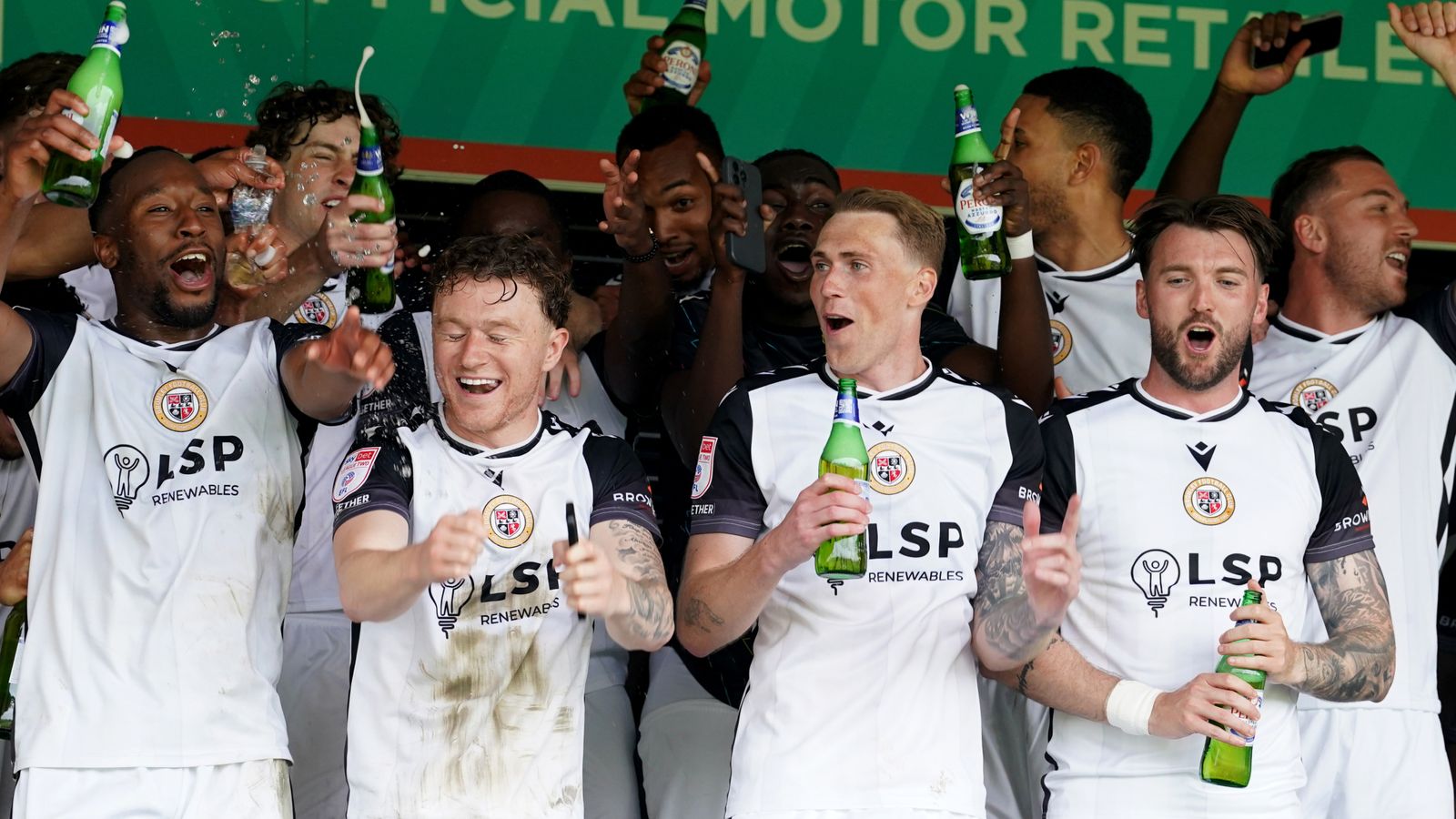
Why tactical transitions will decide the League Two playoff semi-finals
The Playoff Pressure Cooker
League Two playoff football is rarely an exercise in aesthetic perfection. By the time mid-May arrives, legs are heavy, pitches are worn, and the immense financial pressure of reaching League One distorts normal tactical approaches.
This year’s semi-finals present two fascinating stylistic clashes. Notts County face Chesterfield, while Salford City take on Grimsby Town. These are four clubs with vastly different squad-building philosophies and on-pitch identities.
You cannot analyze these games through a standard regular-season lens. The play-offs are a completely different sport. Teams that usually dominate the ball suddenly drop ten yards deeper.
Mid-blocks become low blocks. Risk aversion takes over. But the underlying tactical structures remain. The systems that got these four teams to this point will still dictate the patterns of play, even if the execution is tightened by nerves.
Notts County vs Chesterfield: The Possession Problem
Notts County have been one of the most structurally distinct teams in the English lower leagues for several years. Their commitment to a three-at-the-back system built on exhausting opponents through the ball is absolute.
The mechanics of their build-up play are well documented. The outside centre-backs split wide, the wing-backs push high, and a central midfielder drops into the defensive line to create a temporary back four. It overloads the first line of pressing.
Against most League Two opposition, this is enough to establish control. Teams drop off, terrified of being bypassed by a single vertical pass. But Chesterfield are different.
Chesterfield do not naturally default to a passive block. The key battleground here is the space behind Notts County's wing-backs. When you commit so many bodies forward in sustained possession, the transition defensive shape is inherently fragile.
You are betting that your counter-press will win the ball back within five seconds. If that counter-press fails, the wide channels are completely exposed.
Chesterfield have the athletes to exploit those exact zones. Their wide forwards naturally stay high, cheating defensively, waiting for the turnover. It creates a fascinating tactical standoff for the managers.
Does the Notts County manager instruct his wing-backs to be slightly more conservative? Doing so blunts their primary attacking weapon. But pushing them high risks conceding the tie in a chaotic spell of counter-attacks.
The Pressing Triggers
Chesterfield’s defensive setup will define the rhythm of the first leg. They cannot press Notts County high man-to-man for ninety minutes. The physical toll is simply too high at the end of a grueling 46-game season.
Instead, expect a mid-block that only engages when the ball is played to specific triggers. Usually, this means leaving the central centre-back free, but aggressively jumping on the wide centre-backs the moment they receive a pass.
By angling the pressing runs to cut off the pass back inside, Chesterfield can force Notts County to play rushed, low-percentage balls down the line. That is where possession is turned over.
However, this requires immense tactical discipline. If one Chesterfield player jumps the press early, Notts County will simply play around them. That single mistake instantly takes three or four defenders out of the game.
The discipline of Chesterfield's central midfield pairing will dictate the success of this strategy. They have to shift laterally across the pitch with perfect synchronization. Any gap between the midfield and defensive lines will be ruthlessly exploited by Notts County's advanced eights dropping into pockets of space.
Goalkeepers as Playmakers
We also have to talk about the role of the goalkeeper in the modern League Two system. Notts County demand their keeper act as an auxiliary centre-back during the first phase of build-up.
This allows the actual centre-backs to split incredibly wide, stretching the opposition's front line. It is a mathematical advantage. You create a three-versus-two at the back, ensuring clean progression into the middle third.
But the margins for error are terrifyingly thin. A slightly under-hit pass from the goalkeeper in a playoff semi-final results in an empty net. Chesterfield will try to force exactly this kind of error.
They will occasionally send a third man into the press, abandoning their midfield shape for five seconds to rush the goalkeeper. It is a massive gamble. If the keeper finds the spare man, Chesterfield are completely exposed.
Salford vs Grimsby: The Pragmatic War
The other semi-final is a completely different proposition. Salford City against Grimsby Town is a clash of directness, physical dominance, and set-piece optimization.
Salford’s squad is built on significant investment, featuring players who drop down from higher divisions for one last lucrative contract. Technically, they are often superior to their direct opponents.
But cohesively, they can sometimes look like a collection of disjointed individuals. This is the biggest flaw in Salford’s approach. For all the money spent, their tactical identity remains frustratingly fluid.
They rely heavily on moments of individual brilliance rather than repeatable attacking patterns. When the game becomes a scrap, their midfield often goes missing, leaving vast spaces for opponents to exploit.
Against a team like Grimsby, that lack of an established structural safety net is dangerous. Grimsby do not care about field tilt or possession stats. They care about winning second balls in the middle third.
The Second Ball Battleground
Grimsby play a remarkably effective brand of transition football. They frequently bypass the midfield entirely during the first phase of build-up.
The ball is launched towards a physical target man, and the rest of the team aggressively pushes up to win the knockdown. It sounds archaic, but it is mathematically sound when executed correctly.
It immediately forces the game into the opponent's half. It completely removes the risk of turning the ball over in dangerous defensive areas.
Salford's centre-backs will win the initial headers. They are big enough and strong enough to do so. But winning the first contact is largely irrelevant against Grimsby's system.
It is all about the second contact. Grimsby surround the drop zone with three or four energetic midfielders. If they win that second ball, they are suddenly attacking an unsettled Salford defense that is dropping deep to deal with the initial long pass.
To counter this, Salford cannot just defend the long ball passively. They have to disrupt the supply line. That means closing down the Grimsby centre-backs and forcing them to play the long pass under severe pressure, reducing its accuracy.
Defensive Line Height and Game State
The height of the defensive line will be a major factor in both ties. In the first legs, expect all four teams to drop their lines slightly deeper than their season averages.
No manager wants to concede a transition goal in the first twenty minutes of a playoff tie. The fear of being caught out dictates a more conservative starting position.
As detailed in Sky Sports' live coverage of the ties, the intense scheduling only amplifies this early-game caution.
But as the game state changes, so too must the defensive lines. If Salford go a goal down, they have to push their centre-backs up to the halfway line to sustain attacks.
This is where Grimsby's pace on the counter becomes lethal. They are perfectly built to absorb pressure in a low block and spring forward into the empty space left by an advancing defensive line.
Set-Piece Margins and Officiating Flaws
When two pragmatic teams meet in a high-stakes knockout tie, the game is usually decided by set-pieces. Open play becomes a secondary concern. The focus shifts to winning cheap free-kicks in the final third.
This is where Grimsby excel. Their delivery is incredibly consistent. They use blockers effectively, manipulating the opponent's zonal marking structures to free up their best aerial attackers at the back post.
Salford must be completely disciplined. Giving away needless fouls wide of the penalty area is an immediate tactical failure. But this brings up a serious issue with League Two football at this stage of the season.
The standard of refereeing in these high-pressure games is frequently dreadful. Officials tend to put the whistle away, allowing blatant physical fouls on transition to go completely unpunished.
It ruins the technical setups of teams trying to play through the thirds. It rewards cynical, repetitive tactical fouling and turns midfield battles into disjointed wrestling matches.
If the referee allows the game to descend into a brawl, the advantage swings wildly toward the more physical, destructive teams. Technical players get kicked out of the game without protection.
Tactical Flexibility in the Second Leg
The beauty of the two-legged format is how it alters in-game decision making. A one-goal deficit in the first leg is completely fine. A two-goal deficit requires an immediate structural shift.
If Notts County fall behind early to Chesterfield, do they abandon their patient build-up and start hitting early crosses? Their squad is simply not built for it.
They lack the physical profile in the penalty area to make direct football work. This is why having a distinct style is a double-edged sword in knockout football.
Notts County are brilliant at what they do, but they only really do one thing. If Chesterfield figure out the pressing triggers, Notts County have very few levers to pull to change the momentum.
Salford, on the other hand, have the personnel to change things up. They can bring on an extra striker, switch to a conventional four-man midfield, and start throwing balls into the box. It is not pretty, but it is a viable alternative.
The Midfield Engines
Games of this magnitude are won in the engine room. You need midfielders who can cover ground quickly, win tackles, and immediately distribute the ball securely under pressure.
In the Notts County vs Chesterfield match, the midfield battle is about spatial control. It is about who dictates the tempo and who controls the half-spaces.
In the Salford vs Grimsby tie, the midfield battle is entirely about physical domination. It is about winning the physical duels, picking up the loose balls, and driving the team forward.
A midfield that gets overrun in the first leg will struggle to recover in the second. Momentum in football is often dictated by which midfield trio is winning the loose ball challenges.
Game Management and the Dark Arts
Finally, we have to acknowledge the dark arts of game management. Playoff football is cynical. Players will waste time, feign injuries, and disrupt the flow of the game whenever it suits them.
Teams that try to play purely on technical merit often get frustrated by these tactics. You have to be streetwise. You have to know when to slow the game down and when to speed it up.
Grimsby are masters of this. If they take the lead, they will kill the rhythm of the game completely. They will turn a ninety-minute football match into forty-five minutes of actual ball-in-play time.
Salford need to be prepared for this frustration. They cannot afford to lose their discipline and pick up silly yellow cards for dissent or retaliation. Emotional control is a tactical requirement.
Final Assessment
These two ties offer a perfect cross-section of lower-league tactical thought. We have the purists, the pragmatists, the heavily-funded underachievers, and the efficient overachievers.
Notts County need to prove their system can withstand the immense physical and psychological pressure of a playoff semi-final. Chesterfield need their pressing shape to remain flawless for 180 minutes.
Salford need their expensive individuals to function as a cohesive defensive unit. Grimsby just need to keep doing exactly what they have been doing all season.
There is no room for error. A single misplaced pass in the build-up phase, a momentary lapse in concentration at a corner, or a failure to track a runner can end a season instantly.
Tactics boards are great during the week. But when the whistle blows, it comes down to execution under extreme duress. That is the brutal, unforgiving nature of the League Two playoffs.
Read Next
- League Two playoffs are a beautiful meat grinder and I am here for it
- Salford and Notts County face a brutal path through the League 2 play-offs
- Why Southampton's Spygate scandal makes this playoff tie a toxic tactical war
- Why the League Two play-offs are a physiological meat grinder
- ⚽ EFL League Two 2025-26 — Promotion Race & Play-Off Final Hub
- ⚡ UCL Semi-Finals 2026 — Full Coverage Hub
Inverting The Pyramid: The History of Soccer Tactics by Jonathan Wilson
The definitive bible on how football is really played.
More Coverage
Michael Skubala takes the hot seat at Ashton Gate
3 hours ago
World Sevens brings high-octane chaos before the World Cup fever hits
4 hours ago
Why Manchester United’s pursuit of Ederson makes tactical sense
12 hours ago
Arsenal must reconcile their tactical past with this final hurdle
13 hours ago
Manchester United are sleepwalking into another summer of uncertainty
16 hours agoHow a weird PSG loan turned Mikel Arteta into a manager
19 hours agoMore Analysis
League Two playoffs are a beautiful meat grinder and I am here for it
2 weeks agoSalford and Notts County face a brutal path through the League 2 play-offs
2 weeks agoWhy the League Two play-offs are a physiological meat grinder
2 weeks agoBolton and Stockport set for Wembley clash as League One's tactical divide peaks
2 weeks ago
Bolton and Stockport are fighting for one seat at the table
2 weeks ago