
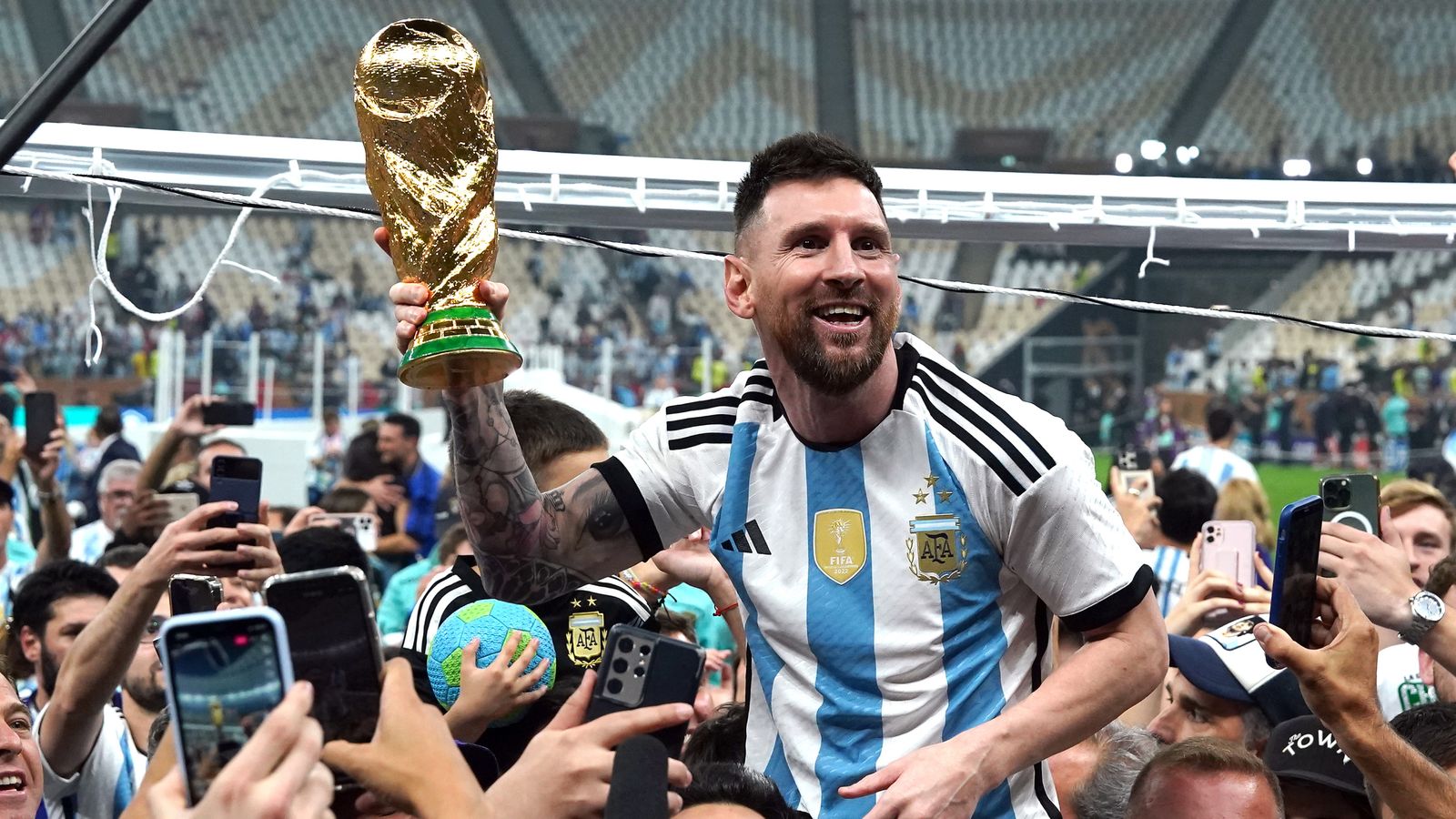
The 76-Day Parallax
We are exactly 76 days away from the World Cup opener in North America. By the time the knockout stages begin, Lionel Messi will be turning 39 years old.
It is a biological and statistical boundary that elite international football rarely respects. Yet, as Sky Sports reported this week, manager Lionel Scaloni admits his captain remains completely undecided on his participation.
This isn't an endearing story about a veteran carefully weighing his options. It is a severe structural roadblock. You cannot design a modern pressing system when your most important forward remains a question mark.
In modern international football, out-of-possession structure is everything. You either press from the front as a cohesive unit, or you drop into a compact, disciplined mid-block. Both require eleven active participants.
The longer the indecision drags on, the more Scaloni is trapped in a tactical holding pattern. He cannot commit to a defensive blueprint without knowing the exact physical profile of his right-sided forward.
The Arithmetic of Attrition
Let's strip away the romance and look at the underlying metrics of physical decline.
At his absolute physical peak during the 2011-12 season under Pep Guardiola, Messi logged a staggering 4,272 minutes across all competitions for Barcelona. He pressed relentlessly. He won the ball high up the pitch and initiated devastating counter-attacks from the center circle.
Compare that workload to his late-career stint in Major League Soccer. Inter Miami has systematically wrapped their franchise player in cotton wool. His minute load has collapsed dramatically as his aging hamstrings require constant, careful management.
You cannot realistically take a 38-year-old forward playing limited, low-intensity minutes against MLS defenses and expect him to survive a modern international tournament. Especially not this one.
Thanks to the expanded 48-team format in 2026, reaching the final now requires navigating an extra knockout round. The eventual champions will have to play eight matches in just 39 days. It is a grueling, attritional sprint that heavily penalizes aging squads.
The Qatar Workaround
During the 2022 tournament in Qatar, Scaloni bypassed the rules of modern pressing. He engineered a brilliant, highly specific tactical workaround to accommodate a static forward.
He deployed Rodrigo De Paul, Alexis Mac Allister, and Enzo Fernandez as a fiercely aggressive, ball-winning trident. They effectively played the roles of four men out of possession, hunting the ball and immediately funneling it to their number ten.
FIFA's tracking data from that tournament was fascinating. It showed Messi spent over 72 percent of his pitch time operating at a walking pace, frequently covering less than five kilometers a match.
It worked perfectly in Doha. But the math has fundamentally changed four years later. The physical toll on that midfield engine room has been incredibly severe.
De Paul is no longer reliably covering 11.5 kilometers per match with the same explosive burst to close down opposition wing-backs. Fernandez has endured a chaotic, physically draining couple of seasons in London. You simply cannot ask a declining, fatigued midfield to do all the running for a 39-year-old passenger.
The Bielsa Blueprint
Opposing teams have already adapted. Look at the underlying numbers from the recent South American qualifying cycles. The distances between Argentina's forward line and their midfield block have started to stretch alarmingly.
High-tempo pressing sides have found joy by completely bypassing the first line of engagement. Marcelo Bielsa's Uruguay provided the perfect tactical blueprint during their victory in Buenos Aires late in 2023.
Uruguay recognized that Messi was entirely static out of possession. They isolated Fernandez and Mac Allister, mathematically overloading the central areas. Bielsa's midfield ran straight through Argentina's structural gaps.
When you field a forward who does not press, your PPDA (passes allowed per defensive action) naturally inflates. Opposing center-backs get comfortable. They have time to pick their forward passes, forcing the midfield trio to drop deeper to protect the back line.
Here is the counterintuitive finding buried deep in Argentina's recent tactical data. The world champions actually look significantly more robust defensively when they play without Messi.
When Julian Alvarez leads the line alongside Lautaro Martinez, Argentina reverts to a relentless, high-intensity 4-4-2 out of possession. Alvarez acts as a hyper-aggressive pressing trigger. The team averages nearly double the high turnovers per match compared to when Messi starts.
Without their talisman, they win the ball higher up the pitch and concede far fewer high-quality transition chances. The defensive floor is raised significantly.
The Bench Dilemma
The offensive trade-off is obvious. If you drop Messi, you lose the greatest creator in the history of the sport. But the statistical reality suggests he is no longer that omnipotent force.
In Qatar, his non-penalty xG+xA (Expected Goals + Expected Assists) per 90 minutes sat around 0.84 xG+xA, comfortably the highest of the tournament. He was a ruthless chance-creation machine.
By the end of the 2024 Copa America, that identical stat had tumbled significantly against familiar CONMEBOL defenses. He became heavily reliant on set pieces and isolated moments of brilliance, rather than sustained, match-controlling dominance.
The tactical solution is blindingly obvious. Messi should travel to North America strictly as a super-sub. A 25-minute problem-solver who enters late against tired legs, eliminating the need for Scaloni to build a complex pressing scheme around his lack of mobility.
But that introduces a massive, potentially toxic internal hurdle. Would a five-time World Cup participant and eight-time Ballon d'Or winner actually accept the indignity of the bench?
It is a psychological gamble that destroyed Manchester United's dressing room dynamic when Erik ten Hag tried it with Cristiano Ronaldo in 2022. The mere presence of a dissatisfied megastar on the bench became a bigger story than the matches themselves.
Scaloni is staring down the exact same barrel. Every day Messi delays his final answer is a day the manager cannot commit to his blueprint. The romantic narrative wants one last dance on American soil. The tactical reality suggests that dance might cost Argentina their structure.
The Possession Paradox
When Messi is on the pitch, Argentina's entire possession structure warps. This isn't just about his lack of defensive work; his offensive gravity fundamentally alters the team's spacing.
In recent qualifiers, Argentina's average attacking sequence time increased by nearly four seconds when Messi played. Everything slows down. The rapid, vertical transitions that characterized their 2022 triumph are replaced by methodical, predictable build-up play aimed entirely at finding the captain's feet.
Opposing managers know exactly how to defend this. You drop into a narrow 4-5-1, choke the central channels, and dare Argentina to beat you with pace down the flanks. With a 39-year-old central focal point, there is no threat of a run in behind to stretch the defensive line.
The data from the last two years of international friendlies and qualifiers paints a stark picture. Argentina's open-play xG (Expected Goals) actually spikes when they deploy a fluid, rotating front three consisting of Alvarez, Martinez, and Alejandro Garnacho.
That trio forces defensive lines to drop five yards deeper out of pure fear of their pace. That extra five yards of space is exactly what Fernandez and Mac Allister need to dictate the tempo from midfield. When Messi plays, the opposition defensive line stays high, perfectly comfortable leaving space behind a forward who no longer has the burst to exploit it.
Scaloni knows this data intimately. He has a sprawling analytics department feeding him these precise numbers after every international break.
He knows the 2026 World Cup will be the most physically demanding tournament in history. The heat, the travel distances across North America, and the brutal eight-game schedule are designed for deep, athletic squads. It is not an environment conducive to carrying a walking playmaker.
The indecision is functionally selfish. Scaloni cannot publicly demand an answer, nor can he simply drop the most revered figure in Argentine history. He is a hostage to his captain's timeline.
Until Messi makes a definitive call, Argentina's tactical evolution is frozen. They are a team caught between the glorious memory of what worked in Qatar and the harsh mathematical reality of what is required to win in North America.
Read Next
- Argentina's biggest World Cup problem is named Lionel Messi
- Why Thomas Tuchel's England are walking into a World Cup disaster
- Steve Clarke's tactical masterclass that dragged Scotland to the World Cup
- Why Garner and Foden starting together is exactly the chaos England needs
- 🏆 World Cup 2026 — Full Coverage Hub
- 🇦🇷 Argentina World Cup 2026 — Defending Champions Hub
