The statistical foundation of the Saudi rearguard
In the match held at the Rostov Arena, Saudi Arabia registered a possession share of only 38 percent. Despite this disparity, they limited Uruguay to an expected goals (xG) metric of just 0.92 during the first 65 minutes. Their disciplined low block forced Luis Suarez and Edinson Cavani to operate in stifled conditions, rarely finding space between the lines.
The Saudi back four remained remarkably compact, maintaining an average vertical distance of 14 yards between the defensive and midfield lines throughout the first half. This restriction caused Uruguay to rely on speculative long balls, with 54 percent of their aerial duels occurring in the final third. Such an approach played directly into the hands of a disciplined aerial unit, yielding a success rate for Saudi defenders of 68 percent in these contested headers.
The evolution of the Saudi goalkeeper
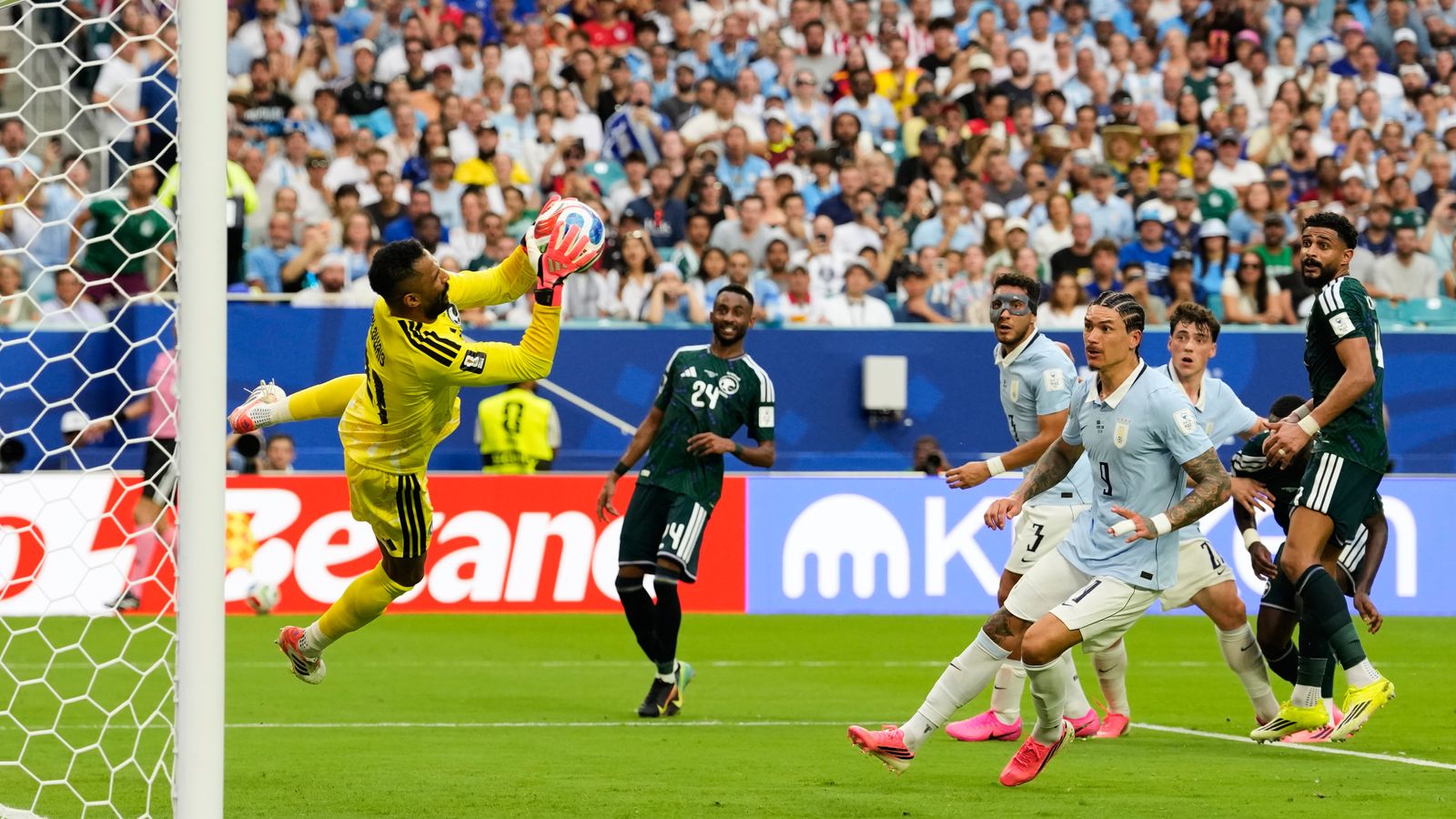
Mohammed Al-Owais was the standout figure, recording 7 saves during the regulation period. His distribution was not merely functional; he completed 88 percent of his short-range passes to escape initial high-press situations initiated by Arrascaeta. This composure allowed the team to transition from a defensive shell into a 4-3-3 shape quickly.
However, the statistical profile of the match shifted after the 70th minute. As Sky Sports reported, the relentless pressure finally compromised the Saudi structure. Uruguay increased their shot frequency from 0.4 per minute to 1.1 per minute in the final sequence. This volume eventually led to the 88th minute equalizer, proving that defensive discipline usually carries a fatigue tax.
Breaking down the defensive collapse
The collapse was not a failure of strategy but a breakdown in transition speed. In the first half, Saudi Arabia required an average of 4.2 seconds to reorganize into their defensive 4-5-1 formation after a loss of possession. By the 80th minute, that number ballooned to 7.8 seconds, creating pockets of space for Uruguay's late surges.
This delay is the exact moment the defensive shape fractured. Midfield runners failed to track the secondary wave of attack, allowing Uruguay to finish with a total of 19 shots. While the Saudis managed to keep the scoreline tight for long stretches, the delta between their early-game recovery speed and late-game fatigue was 3.6 seconds. That discrepancy is why they ultimately conceded a goal that yielded an xG of 0.84, a high-percentage chance generated by poor late-game spacing.
Even with their deep-sitting tactics, they failed to register a single substitution before the 75th minute. This mismanagement of personnel left the primary screening midfielders, who had covered an average of 9.2 kilometers up to that point, to contest the final chaotic minutes against fresh legs. The match serves as a cold reminder that defensive structure without rotation is a ticking clock.
Read Next
- Uruguay's tactical stagnation against Saudi Arabia is a alarm bell
- Why Iran against New Zealand is a tactical mismatch
- Saudi Arabia against Uruguay is a tactical nightmare for the Saudis
- Thomas Tuchel's tactical shuffle risks England's defensive stability
- 🇺🇾 Uruguay World Cup 2026 — La Celeste Hub
- 🇸🇦 Saudi Arabia World Cup 2026 — Green Falcons Hub