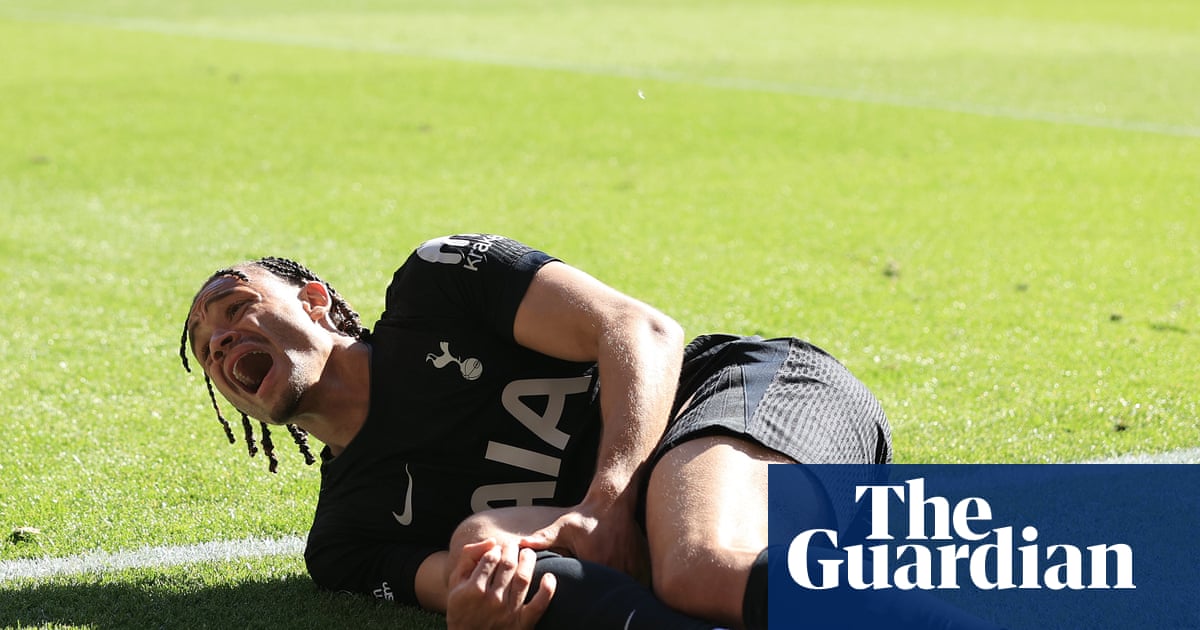
The worst-case scenario for Tottenham Hotspur and the Dutch national team has materialized in brutal fashion. As Sky Sports confirmed, Xavi Simons is done for the season. A severe knee injury has not only derailed Spurs' chaotic campaign but has also cruelly wiped out his hopes of playing in the 2026 FIFA World Cup.
The timing could not possibly be more devastating for the young midfielder. We are exactly 45 days away from the World Cup kickoff in North America. For a player who was widely expected to be the central creative engine for the Netherlands on the global stage, the margins for recovery were already non-existent. Now, the door has been slammed shut entirely.
Spurs confirmed the news officially, putting an abrupt end to any lingering, desperate optimism that the Dutch international might just be dealing with a minor sprain or a bone bruise. When a Premier League club preemptively rules a star player out of a major summer international tournament before the month of May even begins, the scan results are typically grim.
The brutal reality of the recovery timeline
Knee injuries in modern high-intensity football remain the great equalizer. While the exact grading of the tear and the specific ligament involvement haven't been meticulously detailed in the initial public briefs, the projected timeline tells the whole story to anyone paying attention.
Any knee trauma severe enough to guarantee an absolute minimum of a three-month absence right now points directly towards significant structural damage within the joint. We are likely looking at a high-grade medial collateral ligament tear, a complex meniscus rupture that requires a full surgical repair rather than a simple trim, or, most fearfully, anterior cruciate ligament involvement.
If it is indeed an ACL tear, the standard recovery protocol dictates eight to nine months of grueling rehabilitation. That doesn't just kill his World Cup dreams; it completely compromises the entire first half of Tottenham's upcoming 2026/2027 season.
The rehabilitation process for these specific knee traumas is a lonely, miserable grind. Simons is a player who relies heavily on a low center of gravity, rapid deceleration, and incredibly explosive lateral movements to beat Premier League defenders. He doesn't just run in straight lines; he twists, pivots, and changes direction constantly.
Rebuilding the neuromuscular control required to trust that knee again in tight spaces is often significantly harder than the actual physical healing of the grafted tissue. It takes a severe psychological toll to willingly push a surgically repaired joint to its absolute limit again.
A catastrophic failure in Tottenham's squad planning
Medical departments across the English top flight have been fighting a losing battle against the congested modern calendar. However, the sheer volume of intense minutes Simons has logged this season made this outcome feel like a grim inevitability.
This is exactly where Tottenham’s management and recruitment departments need to face some highly uncomfortable truths. The over-reliance on Simons throughout this campaign has been borderline negligent. He has been run into the ground, asked to carry the creative burden of an entire football club on his shoulders twice a week.
Spurs woefully lacked any viable alternative to his specific brand of ball-progression. This forced the medical and coaching staff to continuously roll the dice on his fitness, pushing him out onto the pitch when his physical metrics likely screamed for a rest. They treated a finely tuned, high-performance sports car like a rugged daily commuter, and the engine finally blew out.
It represents a glaring, unforgivable failure of squad building by the Tottenham hierarchy. When your entire transitional attacking threat hinges on one young player remaining completely unbreakable across a grueling 50-game season, you aren't running a serious football operation. You are simply hoping for luck, and luck always runs out eventually.
Tactical isolation for the Premier League run-in
Without him pulling the strings, Tottenham's midfield looks utterly pedestrian and entirely devoid of inspiration. The lack of dynamic ball-carriers will inevitably isolate their forward line even further. Opposing Premier League managers will simply instruct their teams to press higher and more aggressively, safe in the knowledge that Spurs no longer possess a player capable of consistently breaking the lines with a single, sharp turn.
Managerial options in North London are now depressingly thin. Dejan Kulusevski might be forced centrally, a role he has historically struggled to dominate consistently against low blocks. Pape Matar Sarr offers endless industry and running, but none of the subtle, disguised passing that Simons provides. The entire tactical framework, built around Simons receiving the ball on the half-turn, is now defunct.
The ramifications of this prolonged absence will drastically alter the dynamic of the Premier League run-in. Teams fighting for league position directly around Tottenham now have a massive, unexpected advantage handed to them. Spurs are suddenly highly predictable. Stop the wing-backs, and you effectively stop Tottenham. There is no central attacking threat left to worry about in the middle third of the pitch.
Oranje's tactical nightmare in North America
For the player himself, the psychological blow is going to be immense and difficult to process. Simons was arguably playing the best, most consistent football of his young career, peaking perfectly for a World Cup cycle. This tournament in the United States, Canada, and Mexico was supposed to be his defining moment to grab global headlines and establish himself among the absolute elite.
Instead, he will spend the entire summer trapped in a sterile rehabilitation room in London or Amsterdam. He will be doing agonizing straight-leg raises and basic range-of-motion exercises while his international teammates board a trans-Atlantic flight to compete on the biggest stage in sports.
The Dutch national team's tactical blueprint for June just disintegrated in front of their eyes. Simons wasn't just a useful squad player for the Oranje; he was the primary creative conduit for a team that historically struggles badly to break down low defensive blocks without an elite, visionary number ten operating between the lines.
The historical parallels for this kind of pre-tournament heartbreak are brutal to recall. We saw Marco Reus tear ankle ligaments right before the 2014 World Cup, missing out on Germany's eventual triumph. We saw Radamel Falcao's knee completely give out just months before that same tournament, cruelly robbing a highly fancied Colombia side of their generational striker.
The Dutch training camp will be reeling from this news. Their coaching staff now has to fundamentally restructure their entire attacking philosophy with less than two months of preparation time remaining before the tournament begins. You don't just easily replace a player with Simons' unique profile; you have to completely change how the entire team operates in possession.
The long road back to full fitness
The immediate media focus is understandably fixed on the upcoming World Cup and the crucial Premier League matches he will miss. But the long-term reality of this injury is what should truly worry the Tottenham fanbase the most.
Players do return from serious knee injuries in modern football, thanks to rapid advances in surgical techniques. However, they very rarely return looking exactly the same in the first twelve months back on the pitch. There is always a noticeable, frustrating lag period.
The physical tissue might heal perfectly, but the player's brain takes significantly longer to implicitly trust the repaired joint during a chaotic, high-speed collision in the middle of a muddy pitch. Confidence in the knee is earned slowly, often at the expense of early-season form.
Spurs will likely have to enter the upcoming summer transfer market desperately looking for a high-level replacement or a stop-gap loan. They will be doing so knowing full well that their star man won't be operating at his absolute 100% maximum capacity until well into the calendar year of 2027.
The severe knee injury to Xavi Simons is a crushing personal tragedy for the player and an unmitigated disaster for both his club and his country. It serves as a stark, depressing reminder of the incredibly fragile nature of footballing success. One wrong step on the turf, one slightly awkward landing, and an entire season's carefully constructed strategy is rendered completely useless in the blink of an eye.
Read Next
- Spurs' survival hopes might have just vanished with Xavi Simons
- Xavi Simons' ACL tear is a total disaster for Spurs and the Dutch
- Top 10: Top Moments of April 2026
- Top 10: The Definitive Moments of the 2025/26 Football Season
- 🏆 World Cup 2026 — Full Coverage Hub
- 🇳🇱 Netherlands World Cup 2026 — Oranje Hub