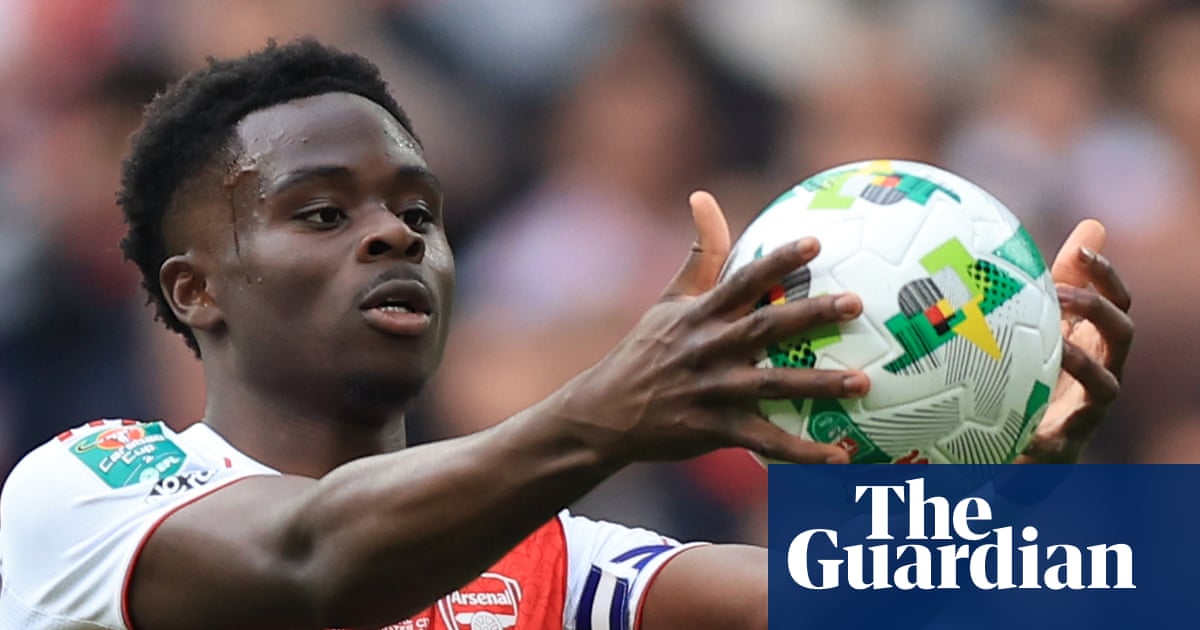
Arteta's injury crisis is a predictable mess of his own making

The cost of the red zone
London Colney is currently less of a training ground and more of a triage center. As Mirror Football reported this morning, the international break has effectively gutted Mikel Arteta’s tactical spine. Declan Rice and Bukayo Saka—the two players Arsenal can least afford to lose—have both withdrawn from England duty with fitness concerns. It is the news every Arsenal fan feared, yet one that any data analyst could have seen coming from six months away.
The numbers behind Saka’s usage are particularly staggering. Since the start of the 2023 season, he has been available for over 95% of Arsenal’s Premier League minutes. That level of load is unsustainable for a winger who is the most fouled player in the division. When you combine that with Rice’s transition into a hybrid #6/#8 role that requires him to cover 12.5km per match, the mechanical failure was inevitable. This isn't bad luck. It is the result of a manager who treats his substitutes like emergency glass-breakers rather than vital squad components.
We are now eight days away from the first leg of the Champions League Quarter-Finals on April 7. If Rice and Saka are not at 100%, the tactical plan for the European stage effectively evaporates. Arteta’s 3-2-5 buildup relies on Rice’s lateral coverage and Saka’s ability to hold the width on the right. Without them, Arsenal become a static, predictable side that recycled possession without the verticality needed to break down elite blocks. The 'injury crisis' label used by Metro UK might actually understate the severity of the situation.
The Max Dowman warning light
While the first team limps toward April, a different kind of storm is brewing in the Hale End academy. Max Dowman, the 16-year-old sensation who has been making seasoned U21 defenders look like training cones, is reportedly being told to look elsewhere. As TeamTalk noted, there is a growing sentiment that Arteta’s rigid preference for established veterans will eventually ruin the careers of the club's brightest prospects. The claim that Arsenal ‘don’t deserve him’ is harsh, but it is grounded in a very real frustration.
Look at Ethan Nwaneri. Here is a talent who broke the Premier League age record and has spent the last two years mostly watching from the bench while an aging Thomas Partey or an out-of-position Kai Havertz takes his potential minutes. If Arteta won't trust Nwaneri in a home game against a bottom-half side, what path exists for Dowman? The manager’s refusal to rotate is a double-edged sword. It keeps the first XI in a rhythm, but it starves the bench of oxygen and drives the elite youth talent toward the exit door.
This lack of trust creates a tactical vacuum. When the stars get injured, the replacements are cold. They haven't played meaningful minutes in weeks. They lack the match sharpness to execute the high-press triggers that Arteta demands. This is why the drop-off from Saka to his deputy feels so precipitous. It isn't just a talent gap—it is a preparation gap. Arteta has built a Ferrari but refused to let anyone else drive it, and now the engine is smoking just as the race reaches the final lap.
The April gauntlet
The schedule between now and the end of May is brutal. We have the UCL Quarter-Finals on April 7 and April 14, followed immediately by the business end of the domestic campaign. If Arsenal are forced to start Jorginho and a semi-fit Gabriel Jesus against a high-transition European opponent, they will be picked apart. The lack of mobility in a Jorginho-Partey pivot is a glaring weakness that elite coaches exploit with diagonal runs into the half-spaces.
During the last three matches before the international break, Rice’s pass completion rate under pressure dropped from 88% to 81%. That is a clear indicator of cognitive and physical fatigue. He was chasing shadows in the second half of games he should have been subbed out of 20 minutes earlier. Arteta’s stubbornness in keeping his best players on the pitch when the game is already won is a trait that serves no one. It is a defensive mechanism born of a lack of faith in his squad depth—a depth he himself helped curate.
The tactical shift required now is immense. Without Saka’s gravity on the right, Ben White is forced to overlap more frequently, which leaves the right-sided center-back exposed to one-on-one counters. We saw this failure in the 2-1 loss earlier this season where the lack of defensive coverage from the wing led directly to both goals. Arsenal are a system team, and when you remove two of the most vital cogs, the entire machine begins to rattle. It requires a level of tactical flexibility that Arteta has rarely shown when his back is against the wall.
The critical failure of imagination
The most damning indictment of the current situation is that it was entirely preventable. Arsenal spent heavily in the summer to build a squad capable of competing on four fronts. Yet, we are sitting here on March 30 with a paper-thin roster because the manager doesn't trust his own recruitment. If the players brought in to provide cover aren't good enough to start an FA Cup tie or a low-leverage league game, then the recruitment strategy is as flawed as the rotation policy.
There is a specific kind of arrogance in thinking you can play the same eleven players for 50 games a season at the intensity Arteta requires. This isn't the 1990s. The physical metrics of the modern game, especially the high-press, high-line system Arsenal employ, demand a rotational cycle. To ignore that is to gamble with the club's season. The injury to Noni Madueke while on England duty is a reminder that these players are always one sprint away from a three-month layoff, yet Arteta continues to drive them into the red zone.
If Max Dowman does decide to leave, it will be a PR disaster that reinforces every negative trope about Arteta’s management. It will tell every 14-year-old at Hale End that their ceiling at Arsenal is the U21s. A club that prides itself on its history of youth development cannot afford to become a place where 16-year-old stars feel their careers will be ruined by staying. The irony is that in his quest for total control and perfection, Arteta might be destroying the very thing that made his project so exciting in the first place.
A tactical crossroads
So, where does the analyst look for a solution? It has to start with a fundamental shift in how the #8 positions are used. If Rice is out, Arteta must resist the urge to play it safe with a double-pivot of veterans. He needs to finally blood the youth. Give Nwaneri the keys. Let him make mistakes. The xG might take a temporary hit, but the long-term health of the squad depends on it. You cannot complain about an injury crisis when you have spent the last two years refusing to develop the players who could have solved it.
The next five games will define the Arteta era. If he navigates the UCL Quarter-Finals with a makeshift midfield and wins, his 'intensity' narrative will be vindicated. But if Arsenal exit Europe with a whimper because his stars are burnt out and his bench is terrified of making a mistake, the questions about his squad management will become deafening. The 3.0 goals per game average they enjoyed in February feels like a lifetime ago now. The reality is a squad that looks exhausted, frustrated, and increasingly fragile.
Arsenal are currently standing at a crossroads. One path leads to a trophy-laden end to the season where the core group survives on pure adrenaline. The other leads to a repeat of previous collapses, where the physical demands of the system eventually break the players tasked with executing it. For a manager who obsesses over every millimeter of the pitch, Arteta seems remarkably blind to the 15% of his squad that he refuses to use. On April 7, the world will see if that blindness costs him everything.
Read Next
- Arsenal's medical room is getting crowded at the worst possible time
- Arsenal's international break nightmare leaves Arteta scrambling
- Arsenal's medical room is currently more crowded than the M25
- Arsenal's mass withdrawal is a cynical masterclass in dark arts
- 🏴 England World Cup 2026 — Three Lions Hub
- ⭐ UCL 2026 — Champions League Quarter-Finals Hub
Adidas World Cup 2026 Trionda Training Ball
Bring the spirit of the 2026 World Cup to your local pitch.
Frequently Asked Questions
Why did Bukayo Saka and Declan Rice withdraw from England duty?
When is Arsenal’s first Champions League Quarter-Final match?
How does Bukayo Saka’s injury impact Mikel Arteta’s tactical system?
Why is there frustration regarding Max Dowman and Ethan Nwaneri?
What are the consequences of Mikel Arteta’s refusal to rotate his squad?
More Coverage

Raheem Sterling's arrest is a disaster for his career timeline
an hour ago
Kieran Trippier is the exact veteran Wolves need right now
an hour ago
Adam Wharton emerges as top summer target for Arsenal's midfield evolution
an hour ago
Manchester United’s Summer Obsession: Why Inconsistency Defines the Strategy
an hour ago
Liverpool chasing Yan Diomande in high-stakes €150m transfer scramble
an hour ago
PSG are finally playing like a team and it is terrifying
3 hours agoMore Analysis
Arsenal's title hopes are currently hanging by a very thin medical thread
1 month, 4 weeks ago
Arsenal's international break is a tactical nightmare
2 months ago
Arsenal's international break nightmare leaves Arteta scrambling
2 months ago
Arsenal's title scrap is looking like a high-stakes emergency room visit
1 month, 4 weeks ago
Arsenal's medical room is currently more crowded than the M25
2 months ago