Arsenal taking a 2-0 lead into the second leg of a Champions League quarter-final is a commanding position. But it is the tactical manner of the victory that should genuinely terrify Chelsea.
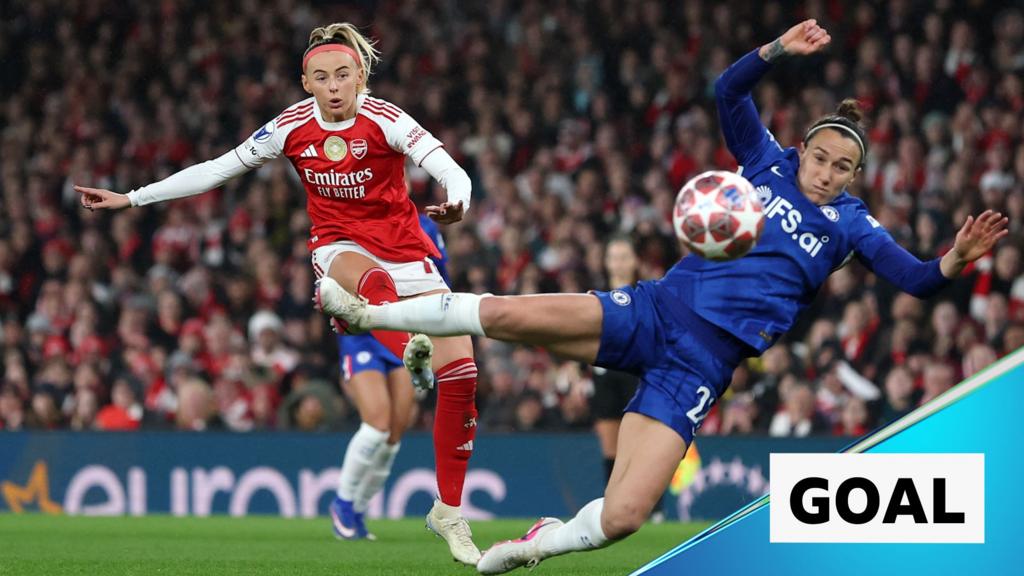
The headline will always belong to Chloe Kelly. Her curling long-range strike was spectacular, an immediate classic that will be replayed on highlight reels for years to come. But focusing solely on the aesthetics of the strike ignores the massive, glaring structural failures from the opposition that allowed her to take the shot in the first place.
Let's break down that goal mechanically. Kelly didn't beat three players off the dribble before unleashing a shot from distance. She received the ball in a pocket of space so vast you could park a team bus in it. The defending was virtually non-existent in Zone 14.
Chelsea's midfield and defensive lines were completely disconnected, operating in different time zones. When Arsenal transitioned the ball forward, Chelsea's midfield was caught inexplicably high up the pitch, failing to apply immediate counter-pressure on the ball carrier. Their defensive line, meanwhile, reacted by dropping immediately toward their own penalty area.
This created a massive 15-yard void just outside the penalty box. Arsenal spotted this spacing issue within the first ten minutes of the match. They continuously bypassed the initial Chelsea press with simple, vertical passes that sliced through the center of the pitch. They constantly found their wingers dropping into the half-spaces, turning and facing the goal with zero pressure on their backs.
It was, frankly, a tactical disasterclass from the reigning English champions. You simply cannot afford to give elite forwards that much time to turn and survey the field in a Champions League knockout tie.
The broken pressing trap
Chelsea's defensive strategy clearly relied on executing a high press. In theory, this disrupts Arsenal's build-up phase and forces turnovers in dangerous areas. In practice, it was entirely disjointed and embarrassingly easy to play through.
Pressing is a collective team exercise. It requires synchronization. If the central striker initiates the trigger and the wingers tuck in to cut off the wide options, the central midfield must step up aggressively to close the passing lanes into the pivot. Chelsea failed at this fundamental concept. They pressed in ones and twos, never as a cohesive unit.
Arsenal's center-backs simply waited for an isolated Chelsea forward to sprint out of the defensive block. Once the forward committed, Arsenal slipped a composed pass into their deepest midfielder. Suddenly, Chelsea were completely bypassed. Five players were taken out of the game with a single, unhurried pass.
This wasn't a one-off mistake born of fatigue in the 80th minute. It was a recurring, systematic theme for the entire 90 minutes. Every time Arsenal broke the first line of pressure, Chelsea looked completely disorganized, scrambling to recover their shape.
It is absolutely worth noting that Arsenal are not exactly infallible in possession. This is where my main criticism of Arsenal lies. Their build-up can still look labored and panicky under genuine, coordinated pressure. We saw clear instances in the first half where a sloppy lateral pass across the backline almost invited Chelsea back into the game. Arsenal have a bad habit of over-complicating their exit strategies when pinned against the touchline.
But Chelsea never sustained the pressure long enough to capitalize on those mistakes. Their failure to punish Arsenal's occasional sloppiness in possession is arguably their biggest failure of the first leg. They let Arsenal off the hook time and time again.
Chasing a ghost in the return leg
Now we look ahead to the second leg. Chelsea face a near-impossible tactical dilemma.
They trail 2-0 on aggregate. They have to attack from the opening whistle. They have to commit bodies forward, push their wing-backs high, and play with a dangerously high defensive line to sustain attacks.
This setup plays perfectly into Arsenal's hands. Arsenal will not need to dictate the tempo of the match. They don't need the ball. They can drop into a compact, narrow mid-block, compress the space between the defensive and midfield lines, and simply wait for Chelsea to make an inevitable passing error.
When that mistake happens, the resulting transition will be devastating. With Chelsea pushing their full-backs high up the pitch to provide necessary attacking width, the wide channels will be completely exposed.
Arsenal's wingers will have 40 yards of open grass to sprint into upon recovering the ball. If you thought Chelsea struggled to handle the counter-attack when the game was level and their shape was relatively conservative, wait until they are desperately chasing a two-goal deficit with only two center-backs left to defend the entire half.
A foundation built on sand
Chelsea’s underlying performance metrics have been hinting at this specific vulnerability for weeks. Their expected goals against (xGA) in transition moments has been slowly creeping up in domestic competition. They have been getting away with it because domestic opponents rarely possess the clinical finishing to punish them.
They rely far too heavily on individual defensive brilliance to bail them out of poor structural situations. A last-ditch sliding tackle to stop a breakaway, an incredible reaction save from the goalkeeper. Those are bandaids, not solutions.
But you cannot rely on individual heroics against elite European opposition. Arsenal are too clinical, too methodical. They probe and stretch the opposition horizontally until a vertical gap appears, and then they strike.
In the first leg, Arsenal didn't even have to work hard to find those gaps. Chelsea practically handed them over with terrible spacing and miscommunication.
Look at the passing networks and average touch positions from the first leg. Arsenal's shape was distinct, balanced, and highly connected. Chelsea's map looked like a scattered mess. Their central midfielders were consistently isolated, forced to cover far too much ground horizontally because the wingers failed to track back effectively.
This is a direct result of their attacking shape leaving them inherently exposed the second they lose possession. When the wingers stay high and wide, and the full-backs overlap to join the attack, a turnover in the middle third spells immediate danger. There is no rest defense. There is only panic.
The second leg verdict
So exactly how does the second leg play out? Chelsea will undoubtedly start aggressively. They have no other choice given the scoreline.
They will likely dominate possession for the first twenty to thirty minutes. They might even pin Arsenal deep into their own defensive third and force a rapid succession of corner kicks. The atmosphere will be tense, the tackles will fly in, and Chelsea will throw everything at the wall.
But possession without penetration is completely useless. And Arsenal's defensive block is incredibly disciplined when they don't have to chase the game.
Arsenal will absorb the early storm. They will willingly allow Chelsea to pass the ball laterally back and forth in front of their defensive block. They will congest the central areas, forcing Chelsea to swing aimless crosses in from wide positions.
And then, right around the 35-minute mark, Arsenal will strike the fatal blow. A poorly executed Chelsea attack will break down on the edge of the Arsenal penalty area. A quick, precise outlet pass will instantly bypass the broken Chelsea counter-press.
Suddenly, Arsenal are running full speed at a backpedaling, entirely exposed defense. One incisive through ball, one clinical finish into the bottom corner, and the tie is completely dead before halftime.
Chelsea might manage to scrape a meaningless consolation goal late in the second half when Arsenal have already booked their hotel for the semi-finals and dropped their intensity. But the damage is already done.
The severe tactical flaws exposed in the first leg simply cannot be fixed in a few days on the training ground. They are fundamental, deeply ingrained issues with how Chelsea transition from attack to defense. You can't rewire a team's spatial awareness in a week.
Arsenal are advancing to the semi-finals. I expect a fiercely contested 1-1 draw on the night, giving Arsenal a comfortable 3-1 aggregate victory. Chelsea's European dream ends not with a dramatic comeback, but with a disjointed, chaotic whimper against a much smarter team.
Read Next
- Why the Champions League quarter-final draw was an absolute stitch-up
- Who actually has the stomach for a Champions League second-leg comeback?
- Why Brazil’s blind women's team is a tactical masterclass
- Unai Emery is about to teach Bologna a brutal European lesson
- ⭐ UCL 2026 — Champions League Quarter-Finals Hub