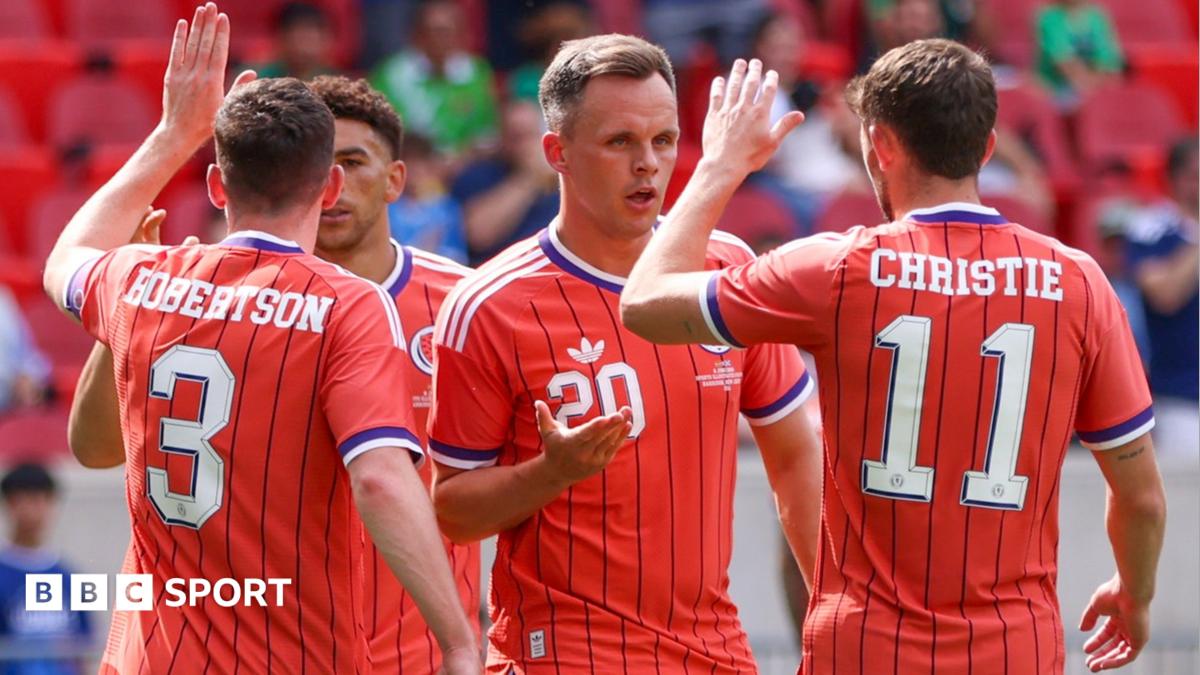
The evolution of Scotland’s central attacking threat
For decades, Scotland struggled to find a reliable focal point. The search for a striker capable of holding the ball under pressure while simultaneously operating as a clinical finisher often resulted in tactical compromise. Now, Lawrence Shankland arrives at this tournament after a prolific period in domestic football. While some critics argue his age profiles poorly for a high-intensity tournament, his movement off the ball suggests a player who finally understands his role in Steve Clarke’s rigid system.
Shankland is not a pace-merchant. He does not beat defenders through explosive acceleration or complex dribbling sequences. Instead, his value lies in spatial awareness within the final third. Watching him in the lead-up matches, the pattern is consistent. When Scotland shifts into a 3-4-2-1, he drifts toward the shoulder of the last defender, waiting for the trigger pass from the midfield pivot. This is classic target-man behavior, yet executed with a modern sense of efficiency.
The structural strain of Clarke’s formation
Clarke relies on a defensive solidity that often sacrifices attacking numbers. The wing-backs are tasked with immense ground coverage, effectively functioning as auxiliary wide players in possession and traditional full-backs during transition. This creates a disconnect. If Shankland drops too deep to collect, Scotland lacks the body density in the box to convert the resulting crosses. The xG per 90 minutes for this squad remains lower than any other side in their group, a stark reality check for those expecting a breakout attacking performance.
There is a recurring issue with the supply line. Against teams that deploy a low block, the Scottish midfield often recycles possession laterally rather than vertically. This horizontal passing volume inflates total pass completion rates without creating genuine scoring opportunities. If the team does not allow Shankland more isolation moments against central defenders, his skill set becomes redundant. Expect to see him frustrated if Scotland continues to prioritize protection over penetration in the opening 20 minutes of play.
Tactical markers for the opening fixture
Watch how often Shankland looks to pull wide to meet cross-field balls. If he stays central, the opponent’s center-backs can manage him easily due to the lack of secondary runs from the attacking midfielders. Clarke needs to encourage more aggressive vertical movement alongside him. Without synchronization between the forward and the second line, Scotland will likely replicate the stagnant patterns seen in the recent friendlies.
The defensive discipline is well-documented, but the lack of an effective counter-pressing trigger is a concern. When possession is surrendered near the halfway line, the central block often retreats too rapidly, allowing opposing teams to settle into a rhythm. This puts immense physical strain on the back three, who must remain in constant communication to neutralize late-arriving runners. Shankland’s role here is vital; he must be the first line of defense, slowing the ball carrier long enough for the midfield to reform.
Closing thoughts and prediction
Scotland’s tournament outcome hinge entirely on their ability to minimize transition errors. They are structurally sound but tactically predictable. Relying on isolated moments of individual brilliance in the box is not a sustainable path to progression. I believe they will draw their opener 1-1, as their inability to effectively close out high-possession games against technical sides remains a major hurdle. Shankland will score, but the defense will buckle late due to pure fatigue.
Read Next
- Scotland’s tactical challenge in the 2026 World Cup
- John McGinn is the heartbeat of Scotland's World Cup hopes
- Liverpool’s summer gamble puts Andoni Iraola in the deep end
- South Korea’s transition game exposes Czech defensive frailty
- 🏴 Scotland World Cup 2026 — Tartan Army Hub
- 🇧🇷 WC 2026 Group C — Brazil, Morocco, Scotland, Haiti
- ⚽ Scottish Premiership 2025-26 — Celtic vs Rangers Hub