There is a number burned into the collective memory of an entire generation of football fans. If you played Pro Evolution Soccer 6, you know exactly what it is. The 99 shot power attributed to Inter Milan’s Adriano wasn't just a high rating. It was a structural flaw in the game's code.
Video games have always struggled to perfectly simulate reality. When developers try to translate human athleticism into raw data, strange things happen. A scout watches a youth game, gives a 15-year-old high potential, and accidentally creates a digital god. A programmer tweaks a physics slider, and suddenly shots from 40 yards become mathematically un-saveable.
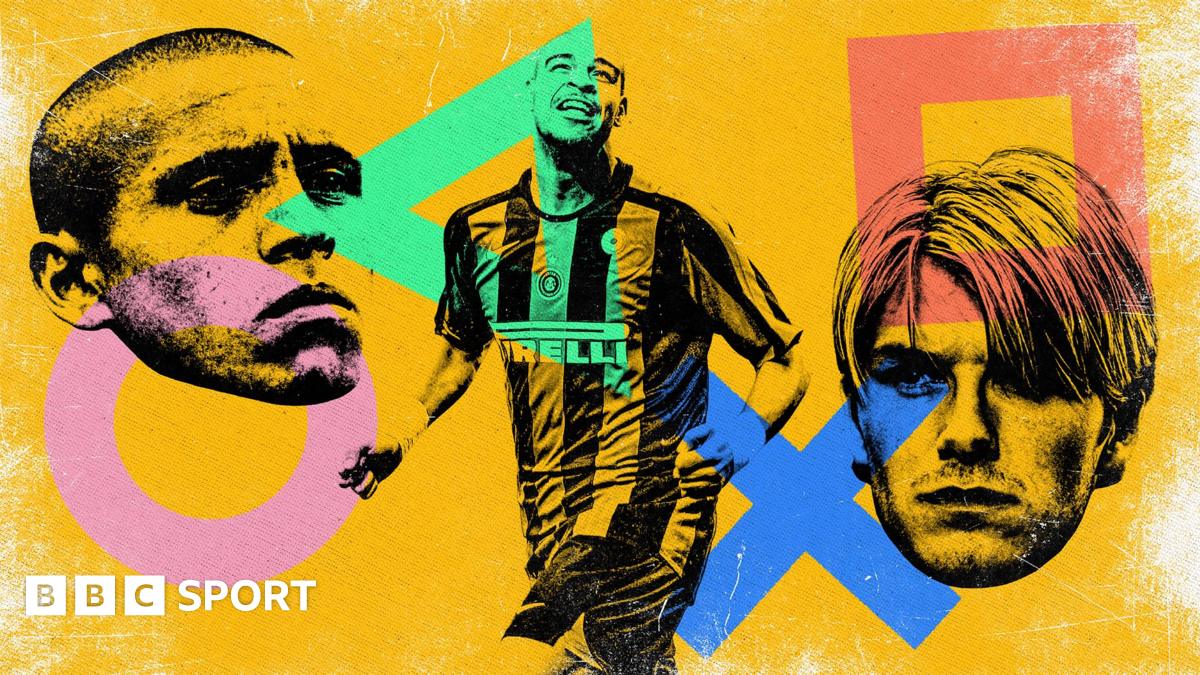
The BBC recently ranked the most iconic video game footballers, singling out Adriano, Cherno Samba, and the legally-distinct R. Larcos. But looking back at these players isn't an exercise in nostalgia. It is a fascinating study of how game engines process football tactics, and how players inevitably find the most ruthless way to exploit those engines.
We like to pretend we want realism. We ask for accurate tactics, fluid passing networks, and intelligent pressing triggers. But the moment the whistle blows, we abandon the whiteboard. We just want the fastest player with the hardest shot.
The physics of a 99 rating
In 2006, PES was the thinking man's football simulator. It rewarded patient build-up and smart movement. But it also contained a glitch wrapped in a blue and black shirt. Adriano Leite Ribeiro was a terrifying prospect in real life. In the game, he was fundamentally broken.
Konami’s physics engine at the time calculated ball trajectory dynamically, based on the player's stats, the ball's momentum, and the body angle upon striking. When a player with maxed-out power hit a dipping shot, the ball traveled faster than the goalkeeper animations could trigger.
You didn't need to work the ball into the box. You just needed to get Adriano on his left foot anywhere within 40 yards of the net. The engine would calculate the velocity, realise the keeper's dive frames couldn't physically match it, and the ball would tear through the net. It was a mathematical certainty disguised as a football match.
What made Adriano truly unplayable, though, was his balance. He boasted a 98 rating for body control. If a defender like Alessandro Nesta or Lilian Thuram tried to muscle him off the ball, the engine favoured the attacker's mass. The defender would bounce off the collision mesh, leaving Adriano free to unleash another ridiculous strike.
Tactical shape became irrelevant against him. You could play a low block, drop your defensive line to the edge of the six-yard box, and park two defensive midfielders in front of the back four. It didn't matter. Adriano didn't need to bypass your block. He just shot through it.
R. Larcos and the overlapping full-back meta
Long before modern managers changed how we view full-backs in the real world, International Superstar Soccer Pro Evolution had R. Larcos. Konami didn't hold the FIFPro license, so Roberto Carlos was given a fake name. They didn't fake his attributes, though.
In the late 90s, the tactical meta of football video games was rigidly flat. Most players used a standard 4-4-2. The artificial intelligence didn't know how to track full-backs making aggressive overlapping runs. Wingers stayed wide, full-backs stayed deep.
R. Larcos possessed a 19 speed rating, the maximum available on the old statistical scale. If you deployed him at left-back, he would routinely bypass the opposing right-midfielder. The AI simply wasn't programmed to drop a winger deep into their own defensive third to track an advancing full-back.
This created a permanent two-on-one on the left flank. You could sprint to the byline, cut inside, and shoot. Like Adriano, his shot power was maxed out. It was a tactical exploit based entirely on the AI's inability to comprehend modern full-back movement. You were exploiting a gap in the programming logic, not a gap in the defence.
Real Madrid effectively used him as an auxiliary winger in reality, but in the game, he was a one-man overload. Defending against him required you to manually drag a centre-back out of the middle, leaving your penalty area completely exposed to a cross. It was a lose-lose scenario.
The Championship Manager probability curve
Text-based simulation games run into a different problem entirely. Championship Manager and Football Manager don't have graphical physics engines to exploit. They have massive databases built on human scouting reports. And humans make mistakes.
Cherno Samba is the patron saint of scouting errors. In Championship Manager 01/02, the Millwall youth player was coded with a dynamic potential ability. Often, that number rolled close to the maximum 200 potential ability threshold when you started a new save file.
The match engine for CM 01/02 was effectively a complex text calculator. It weighed an attacking player's finishing and off-the-ball movement against the defender's positioning and marking attributes. Because Samba's physical and technical stats peaked so early in the simulation, he routinely broke the engine's maths.
It wasn't just Samba. The CM 01/02 database is legendary for its free agents and cheap buys. You could build a Champions League-winning squad with essentially no budget, provided you knew which names to search for.
- Taribo West: Available for £0 on day one, possessing elite tackling and marking stats that made him instantly world-class.
- Mark Kerr: A Falkirk midfielder who cost pennies but consistently averaged an 8.00 match rating running the engine room.
- Maxim Tsigalko: A Belarusian striker who could reliably score 60 goals a season due to a massive bug in his hidden attributes.
Tsigalko is the most interesting case study of the bunch. His visible stats were good, but his hidden Important Matches and Consistency attributes were programmed perfectly. The engine valued these background numbers heavily during critical moments.
When the text commentary flashed 'Tsigalko hits a ferocious drive', the game had already calculated a goal before the text finished rendering on your screen.
Gamers figured out how to break the CM 01/02 engine even further with the infamous 'Diablo' tactic. By placing a central midfielder with an arrow pointing into the striker position, the AI defence simply stopped marking him. The opposing centre-backs would hold their line, the defensive midfielders wouldn't track back, and your attacking midfielder would walk through the centre of the pitch unchallenged.
Pace abuse in modern simulation
As we moved into the 2010s, FIFA took market dominance from PES. EA Sports built their game on the Ignite engine, and later transitioned to Frostbite. Both of these engines shared a fatal, game-breaking flaw. They heavily over-indexed sprint speed at the expense of everything else.
This brings us to the dark days of FIFA 15. The game was entirely dictated by pace. If you had a slow centre-back, you were going to lose the match. It didn't matter if you were controlling Paolo Maldini or Franz Beckenbauer. If a fast attacker knocked the ball past him, the animation lock prevented the defender from recovering his ground.
Victor Ibarbo and Seydou Doumbia became the most feared strike partnership in digital history. Ibarbo had a terrifying 93 pace rating. His finishing was mediocre, his passing was poor, and his tactical awareness was non-existent. The engine didn't care.
The tactical setup was brutally simple. Play a 4-3-3, sit your defensive line incredibly deep, and hit high through-balls over the top of the opposition defence. The ball physics were strangely floaty, meaning AI defenders struggled to track the flight path of aerial passes.
Ibarbo would simply outrun the tracking centre-back, latch onto the bouncing ball, and finish. It was an aesthetic nightmare. Midfields were completely bypassed. You didn't need a playmaker to dictate the tempo when you could just hammer the triangle button and watch your forwards run in a straight line.
EA Sports eventually patched the engine in later iterations, nerfing over-the-top through balls and making defenders more responsive. But for 12 months, the global competitive meta was dictated by a Colombian forward playing for Cagliari.
Modern football games have largely eliminated these anomalies through live updates. In the current era of Ultimate Team and weekly squad patches, a broken player is nerfed within days. If a striker has elite pace but can't trap a bag of cement in real life, the developers adjust the sliders.
That is what makes Adriano, Tsigalko, and Samba so enduring. They are trapped in amber. Because older games were released on physical discs without mandatory internet updates, the mistakes were permanent. Adriano will have maxed-out shot power forever. Taribo West will always be a free agent in the summer of 2001.
These numbers represent a distinct point in football history, viewed through a flawed digital lens. They remind us of an era before expected goals and pass completion maps dominated our analysis. Back then, a scout's subjective opinion was hardcoded onto a CD-ROM and shipped to millions of homes. Occasionally, those scouts got it spectacularly wrong, creating digital legends that outlasted reality.