Wembley's Unprecedented Spectacle
Wembley Stadium is no stranger to high drama, but Saturday's Championship play-off final arrives with an atmosphere stained by unprecedented institutional chaos. Middlesbrough, originally eliminated in the semi-finals, find themselves back on the hallowed turf after Southampton's systematic training-ground espionage resulted in a stunning expulsion. While the administrative dust settles, Kim Hellberg and Sergej Jakirovic must guide their squads through the tactical implications of a final that felt impossible a week ago.
As The Guardian reported, the spygate scandal threw both clubs into a bizarre training limbo. Middlesbrough's squad went from tears of defeat to an emergency recall to Rockliffe Park, while Hull City prepared quietly after dispatching Millwall. For fans tuning in via Sky Sports LIVE or checking how to watch Hull vs Middlesbrough, this represents a collision of two wildly different footballing philosophies under extreme psychological pressure.
Southampton had dispatched Middlesbrough by an aggregate score of 2-1 before their training-ground spying was uncovered. The emotional toll on Boro has been immense, with Hellberg admitting that his players have endured a massive emotional rollercoaster. Conversely, Hull City have enjoyed a serene, uninterrupted preparation cycle that gives them a distinct physical and mental advantage.
The logistical chaos behind the scenes has matched the frenzy on the pitch. Over fifteen thousand tickets originally allocated to Southampton fans had to be rapidly re-processed and distributed to Middlesbrough supporters in under seventy-two hours. This sudden influx of red shirts will transform Wembley into an incredibly hostile environment for Hull.
Jakirovic's Passive Mid-Block vs Boro's High-Stakes Press
Sergej Jakirovic has built a defensive masterpiece at Hull City by prioritizing spatial control over high-tempo pressing. Hull out of possession drop into a compact, low-risk 4-4-2 mid-block designed to compress the distance between their defensive and midfield lines. Vice-captain Charlie Hughes anchors this defense with exceptional composure and a pass completion rate of 88.4%.
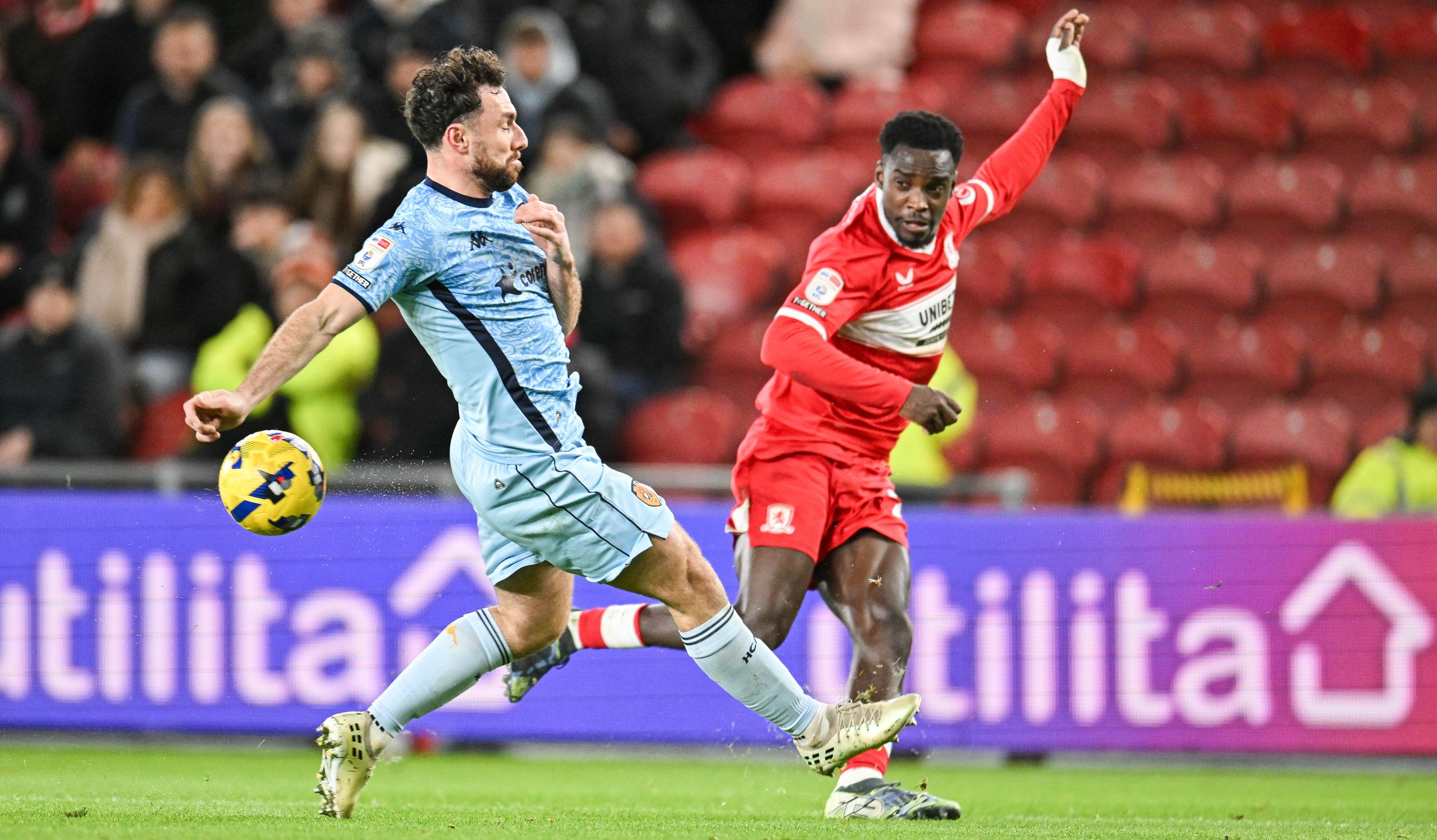
Hughes is not merely a stopper; his ability to break lines with progressive vertical passes into Amir Hadžiahmetović is Hull's primary transition vehicle. Right-back Lewie Coyle provides the defensive balance, rarely venturing past the halfway line to ensure Hull maintain a constant three-man rest defense. During the 74th minute of Hull's semi-final victory over Millwall, we saw a perfect example of this: even as Ryan Giles overlapped, Coyle stayed pinned inside his own half, forming a solid three-man backline with Hughes and Paddy McNair.
In possession, Hull’s shape morphs into a fluid 3-2-4-1, with Cody Drameh pushing high into the right half-space while Mohamed Belloumi isolates the opposing left-back. This asymmetry is designed to create numerical overloads in the final third, forcing Boro's midfielders to slide across and leave the center vulnerable. If Boro's defensive transition is slow, they will be caught in underloaded scenarios in wide areas.
Middlesbrough, by contrast, are defined by Hellberg's aggressive, front-footed press. Boro boast a league-leading PPDA of 8.6, seeking to choke opponents in their own defensive third. Aidan Morris acts as the primary destroyer in midfield, executing pressing triggers the moment an opposing centre-back opens their body shape.
Morris averaged 4.2 tackles and interceptions per 90 during the regular season, making him the enforcer to disrupt Hull's build-up. This high-risk approach creates a fascinating tactical battleground. Hull's mid-block wants to invite Boro's press, hoping to bypass the first wave with quick, vertical sequences.
If Hadžiahmetović can turn under pressure, he will find acres of space behind Boro’s aggressive full-backs. In their March encounter at the Riverside, Hull’s mid-block restricted Boro to a mere 0.65 xG. The vast majority of Boro's 14 shots originated from outside the eighteen-yard box, showcasing Jakirovic’s defensive block denying high-value shot locations.
The Half-Space Dilemma: Life Without Hackney
The biggest tactical talking point heading into Wembley is the fitness of Hayden Hackney. The Championship Player of the Year has been out with a calf injury since March, missing the regular-season run-in and the semi-final legs. While Hackney has returned to training, Hellberg's decision to name him on the bench leaves a gaping creative void in Boro’s starting midfield.
When Hackney plays, Boro play through the lines at will, with the academy graduate ranking in the 98th percentile for progressive passes (7.8 per 90). Without Hackney's elite press-resistance and progressive carries, Boro's build-up play becomes significantly more predictable. Law McCabe and Alan Browne are energetic runners, but they lack Hackney's ability to manipulate defensive lines with subtle body feints.
In their last outing without Hackney, Boro's progressive pass map was a barren wasteland, showing a massive reliance on U-shaped passing around the back four. This central congestion will force Boro to funnel their attacks wide to Morgan Whittaker. Whittaker has been Boro’s main goal threat, cutting inside from the right flank onto his favored left foot.
Tommy Conway will need to play the game of his life to break the structural rigidity of Charlie Hughes and Paddy McNair. Conway’s primary strength lies in his blind-side runs, constantly shifting onto the shoulder of the weaker centre-back. Without Hackney's early vertical releases, however, Conway risks becoming an isolated figure chasing hopeless long balls.
However, he will face a direct duel against Hull's defensive structure, which excels at double-teaming wide playmakers. Hull’s offensive strategy will rely on the physical presence of Oliver McBurnie. McBurnie is an expert at winning aerial duels and pinning centre-backs, creating secondary space for Mohamed Belloumi to exploit.
Belloumi's late runs into the penalty box will test Dael Fry's spatial awareness. During a 2-0 defeat in late April, Fry was repeatedly caught flat-footed by simple over-the-top balls. This is a vulnerability that McBurnie is perfectly equipped to exploit.
The Verdict: Wembley's Tactical Resolution
This final will not be decided by individual brilliance, but by which manager manages the transition phases better. Middlesbrough possess the higher ceiling, but their defensive line is incredibly vulnerable to direct, vertical exploitation when their press fails. Hull City are built to survive storms, and their superior preparation time will manifest in the second half.
Hellberg's in-game adjustments will be vital if Boro find themselves trailing in the second half. Introducing a fit-again Hackney in the 60th minute could inject the central press-resistance and vertical pass-completion they need to break Hull's stubborn mid-block. If Jakirovic responds by dropping into a low block, the final half-hour will become an intense test of tactical endurance.
Expect Boro to dominate early possession, pushing Hull back into a deep block. However, Hull’s defensive shape is too disciplined to break down without Hackney's central gravity. As the match wears on, Boro's physical fatigue from their disrupted schedule will begin to show.
Our prediction is a disciplined, tactical masterclass from Hull City. They will weather the early Boro storm, exploit a high-line transition in the second half, and secure promotion. You can follow the action live on the Sky Sports LIVE stream as this incredible season reaches its dramatic climax.