
The Etihad Simulation is Running at Peak Clock Speed
It is May 14, 2026, and we are all living in Pep Guardiola’s world while he is just overclocking the local hardware. Watching Manchester City dismantle Crystal Palace felt less like a football match and more like watching a high-end GPU benchmark a 15-year-old game. There was no lag, no stuttering, and absolutely no hope for the opposition.
You know exactly what time of year it is. The skies in Manchester are still irritatingly grey, but the pitches are slick, the stakes are absurdly high, and City have transformed into that unfeeling, remorseless footballing terminator we all dread. They don't just beat teams in May; they digest them.
Crystal Palace rolled up to the Etihad hoping to be the plucky underdog story of the week. Instead, they were fed headfirst into the sky-blue woodchipper.
A 3-0 scoreline honestly flatters Palace. It flatters them immensely. It felt like City had snuck an extra three players onto the pitch while the referee was checking his watch. They starved Palace of the ball, suffocated their passing lanes, and pressed them into total submission before the half-time pie warmers had even been turned on.
The Illusion of the Upset
All week long, the pundits tried to sell us on the illusion of an upset. They pointed to Palace’s recent run of decent away form. They highlighted how difficult they can be to break down. They tried to manufacture narrative tension out of thin air because, let's be honest, broadcasters have to justify the subscription fees somehow.
We were told that Glasner had a masterplan. We were told that City might have one eye on the Champions League final on May 28, that they might rotate heavily, that they might take their foot off the gas.
What a load of absolute nonsense.
Guardiola doesn't do rotation when there are points on the line in May. He sent out a starting eleven that cost more than the GDP of a small island nation, and they played with the intensity of a team fighting relegation. The pre-match hype evaporated the moment the referee blew the whistle and City took their first touch. The ball pinged around the pitch with an audible zip, and you could practically see the hope draining from the Palace players' eyes in real time. It is cruel to build up the fans' hopes like that, only to watch them get systematically dismantled by a passing drill.
The Refreshing Honesty of Oliver Glasner
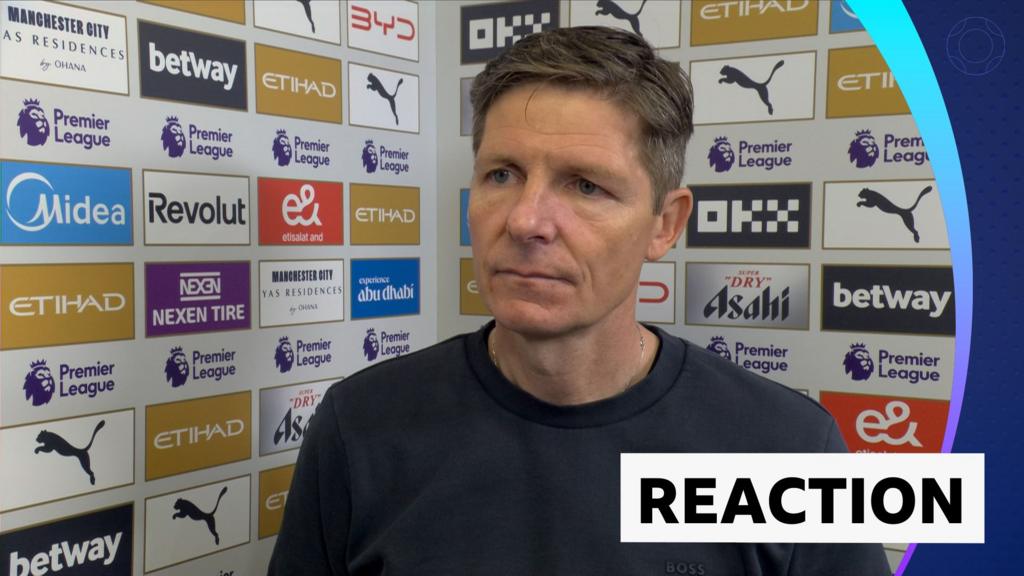
In the post-match press conference, as highlighted by the BBC, Oliver Glasner didn’t even bother trying to spin it. He didn't fire up the usual managerial PR machine.
"Manchester City were too good."
That was it. That was the whole mood. He didn’t complain about a marginal offside call. He didn’t bemoan a missed half-chance in the opening ten minutes that supposedly would have changed the entire game. He just offered a weary shrug and admitted that his squad had been completely outclassed by a vastly superior organism.
There is something deeply refreshing about that kind of honesty. Most managers in his position would have trotted out the usual exhausting clichés. We would have heard about taking the positives or dusting ourselves down or some nonsense about how the boys showed character.
Glasner just gave it to us straight. What else was he supposed to say? We all watched the same ninety minutes of televised torture. We all saw Palace get penned into their own penalty area, frantically clearing the ball only for it to act like a boomerang, returning to the feet of a City midfielder three seconds later. Admitting defeat isn't a sign of weakness when the opponent is operating on a completely different plane of athletic existence. It is just basic reality.
The Anatomy of a Mauling
Let's actually break down what happened out there, because the tactical disparity was staggering. Palace actually came out with a somewhat coherent defensive shape. They operated in an ultra-low block, packing the center of the pitch, dropping their wingers into full-back positions, and daring City to beat them through a forest of legs.
It worked for exactly fourteen minutes. Then City just adjusted the tactical sliders.
They didn't panic. They never panic. They just started moving the ball slightly faster. The passing tempo went from crisp to violent. Rodri, who I remain convinced is actually a cyborg sent from the future specifically to recycle possession, began dictating the rhythm from the center circle with terrifying precision.
The opening goal was a joke. It was a sequence of rapid-fire triangles on the edge of the box that left the Palace defenders literally spinning in circles. By the time the ball was squared across the six-yard box for a tap-in, you almost felt bad for the goalkeeper. He was just a spectator with a front-row ticket to his own demise.
And that is the fundamental problem with playing this iteration of City. You can have a detailed game plan. You can execute that game plan flawlessly for a portion of the match. But the absolute second you blink, the moment a midfielder takes a heavy touch or a center-back loses focus to check his surroundings, they punish you. They do not forgive mistakes. They aggressively monetize them.
The Cowardice of Damage Limitation
But here is where I have to drop the hammer on Crystal Palace, because Glasner’s honesty doesn't excuse his team's total lack of spine.
Palace didn’t even try to counter-punch in the second half. Yes, City are brilliant, but Palace treated the final forty-five minutes as an exercise in sheer damage limitation. They firmly parked the bus when they were already two goals down.
Where on earth is the ambition? Where is the desire to at least make Ederson get his gloves dirty? He could have set up a deckchair and read a novel during the second half.
You cannot just roll over and accept a beating, even against Guardiola's finely tuned machine. The lack of fight from Palace in the closing stages was embarrassing to watch. They looked like a team that had mentally checked out, physically present on the pitch but psychologically already sitting on the team bus heading back down the M6.
If you are going to lose, at least go down swinging. Throw a chaotic long ball. Put a crunching, legal tackle on a midfielder to let them know you exist. Palace did none of that. They were compliant victims, and that is a massive red flag for Glasner's dressing room culture. You can praise the opponent, but you should never surrender to them before the final whistle.
The Sterility of Footballing Perfection
This brings me to a much larger, more uncomfortable point about Manchester City in 2026. They are brilliant. They are undeniably one of the greatest club sides English football has ever produced.
But my god, they can be boring to watch.
It is a sterile, suffocating brand of perfection. It is football played by a relentless algorithm. Every pass is calculated, every movement is drilled into muscle memory over thousands of hours on the training pitch. There is very little genuine chaos, very little off-the-cuff brilliance that hasn't been pre-approved by the manager standing on the touchline.
When you watch them win a game 3-0 without breaking a single drop of sweat, it feels less like a sporting contest and more like a mathematical equation resolving itself in real-time.
You appreciate the sheer, undeniable genius of it, but it doesn't always make your pulse race. It lacks the raw, chaotic energy that is supposed to make the Premier League so intoxicating. We tune in for drama, for mistakes, for the unpredictable nature of human error. City have systematically engineered human error out of their game.
The Financial Elephant in the Room
The financial disparity is the massive, sky-blue elephant in the room that no one really wants to talk about during a title run-in. When City can casually bring a player worth £80m off the bench in the 75th minute just to kill the game and rest legs, the competitive integrity of the league feels impossibly thin.
Glasner knows this. Every single manager in the bottom half of the table knows this. You show up, you try not to get embarrassed on national television, and you pray you don't pick up any devastating hamstring injuries to your actual key players. The fixture is essentially a write-off before the whistle blows.
This financial gulf creates a situation where City are playing a different sport to the rest of the division. They are playing chess while Palace are trying to figure out the rules of checkers.
The Dreaded May Run-In
So what does this mean for the rest of the season? City are purring. They have hit that terrifying, inevitable gear they always seem to find right when the calendar flips to May.
The Champions League final is looming large on May 28, just a measly two weeks away. If they play anything like they did against Palace tonight, whoever meets them in that final is in for a long, thoroughly miserable ninety minutes.
The players look remarkably fresh for this stage of the campaign. Guardiola looks as maniacally hungry as ever. The entire system is functioning with a terrifying, ruthless efficiency.
For the rest of the Premier League, the prevailing feeling is one of grim, unavoidable resignation. You can build a great squad. You can have a fantastic tactical setup. You can even have a manager as pragmatic and honest as Oliver Glasner.
But when City are in this mood, when they are moving the ball with this kind of blistering speed and geometric precision, you are quite literally just making up the numbers. Glasner simply said out loud what the rest of the footballing world was already thinking. They are just too good. And until someone figures out how to short-circuit Pep's supercomputer, everyone else is just fighting for the scraps.


