
The handball rule is officially broken and the Celtic penalty drama proves it
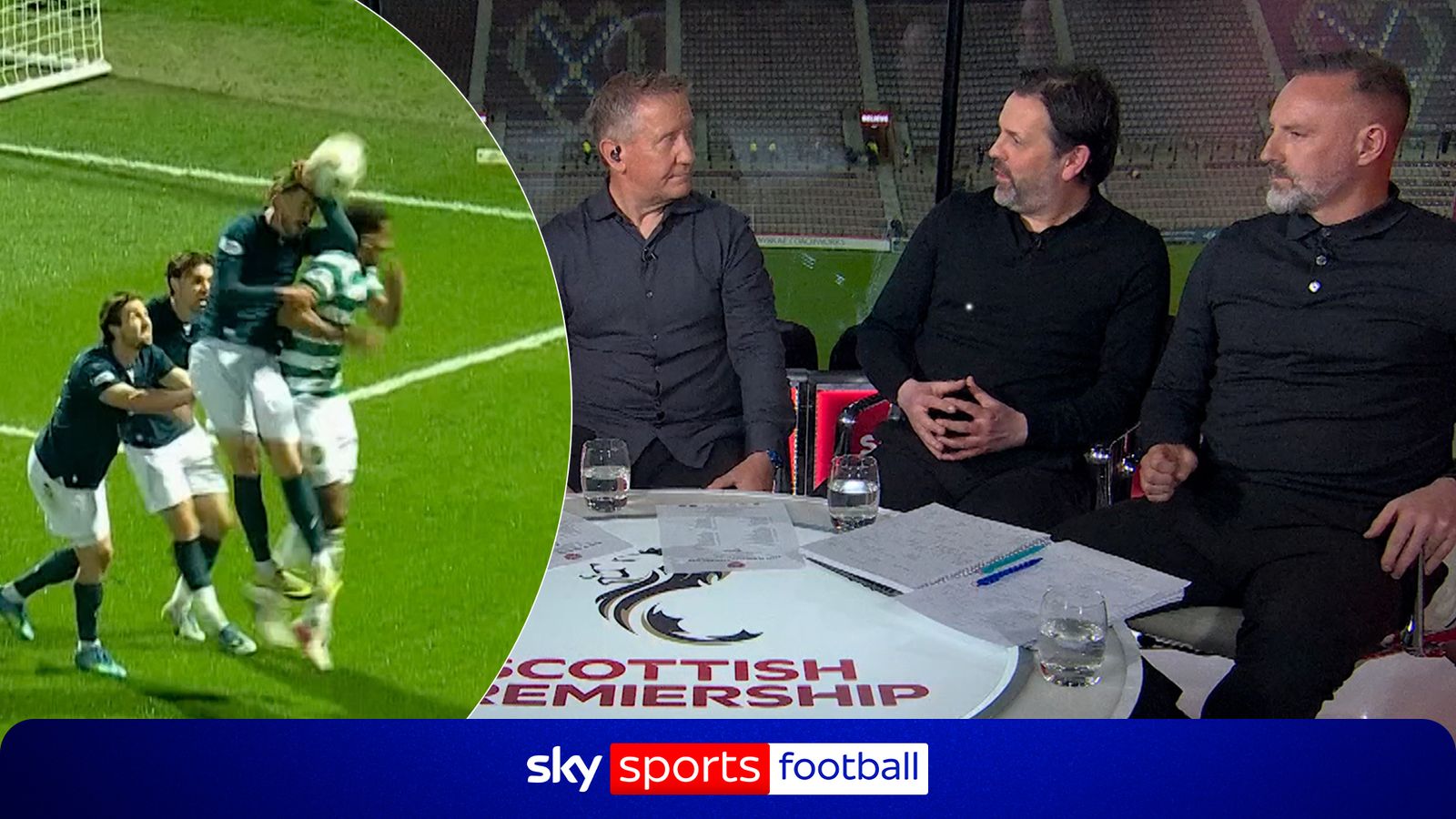
The 89th-minute whistle that changed the title race
Glasgow in May is rarely a place for level-headed discourse, but the scenes following Celtic’s late VAR-awarded penalty have pushed the Scottish Premiership into a full-blown existential crisis. We are seeing a fundamental disconnect between the laws of the game and the physical reality of playing it. When the ball was whipped in during the dying embers of the match, the contact looked incidental at best and non-existent at worst.
As Sky Sports pundits debated the call, the friction between Kris Boyd and Paul Hartley served as a perfect microcosm for the confusion currently reigning in the SPFL. The decision to award a penalty for what appeared to be a header off the shoulder or the very top of the bicep is not just a refereeing error. It is a symptom of a VAR protocol that has begun to prioritize freeze-frames over the natural mechanics of human movement.
Tactically, Celtic had spent the previous 80 minutes hammering against a low block that refused to splinter. Brendan Rodgers had his side operating in a high-intensity 4-3-3, with the full-backs inverted to create a five-man attacking line, yet they lacked the creative spark to find a breakthrough via open play. Then came the cross, the scramble, and the inevitable finger to the ear from the referee.
The physics of the 'header' versus the bicep
The crux of the argument, as Kris Boyd vociferously pointed out, is that the ball appeared to make primary contact with the player's head before skimming an arm that was in a completely natural position for a jumping athlete. You cannot jump for a header with your arms stapled to your sides. It is a biological impossibility. Yet, the VAR official spent nearly four minutes looking at a grainier-than-usual angle before advising an on-field review.
When you watch the replay at full speed, the ball changes trajectory in a way that is consistent with a glancing header. The frame-by-frame analysis, however, allows for an interpretation where the ball brushes the sleeve. Under the current IFAB guidelines, the 'silhouette' of the body is the measuring stick, but that stick is being used to beat defenders who are simply trying to navigate the laws of gravity. This wasn't a deliberate 'hand to ball' movement; it was a 'ball to man' incident at point-blank range.
Celtic’s conversion of the subsequent spot-kick puts them in a commanding position at the top of the table, but the victory feels hollow to anyone who values the flow of the game. We are reaching a point where the most effective attacking strategy in the Scottish top flight is no longer a well-timed overlapping run, but rather a hopeful lofted ball into a crowded box, praying for a stray limb to be caught on a 4K camera.
Punditry in the age of the slow-motion replay
The debate between Boyd, Hartley, and Robertson was a fascinating look at how tribalism intersects with technical analysis. Paul Hartley defended the decision by citing the 'unnatural' position of the arm, a phrase that has become the ultimate get-out-of-jail-free card for referees. But what exactly is 'unnatural' when a center-back is mid-air, spinning to track a deflected cross? The arm was used for balance, not to obstruct the goal-bound path of the ball.
Kris Boyd’s frustration was centered on the 'clear and obvious' threshold, which seems to have been lowered to 'vaguely debatable.' If a room full of former professionals cannot agree after seeing twenty angles, how can a VAR official claim there is a definitive error? This over-correction is killing the spontaneity of the sport. The delay alone sucked the life out of the stadium, turning a high-stakes football match into a tedious legal deposition.
The statistical reality is that penalty awards are up by 22 percent since the introduction of this specific handball interpretation in Scotland. We are incentivizing defenders to defend like statues, which only aids technical teams like Celtic who thrive on quick lateral movements. If you can't use your arms to pivot, you lose the half-yard of pace required to track an attacker like Kyogo Furuhashi.
A critical failure in Celtic’s offensive output
While the penalty will dominate the headlines, the real story for Celtic fans should be the team’s inability to score from open play against a side sitting in the bottom half of the table. Rodgers' side dominated 74 percent possession but managed only three shots on target before the penalty incident. The reliance on late-game set-piece drama or officiating intervention is a worrying trend for a team with title ambitions.
The midfield trio looked stagnant. There was a lack of verticality in the passing, with most of the ball progression happening in safe, U-shaped patterns around the edge of the final third. When the opposition sits this deep, you need players who are willing to take risks, to drive into the box, or to pull the trigger from distance. Instead, Celtic seemed content to wait for the mistake that eventually came in the form of a controversial whistle.
This win might look like 'champion's grit' on the league table, but under the hood, the engine is misfiring. If they carry this level of performance into the upcoming European qualifiers or even the final weeks of this domestic campaign, they will find that luck—and VAR—eventually runs dry. Relying on the referee to see a handball where the pundits see a header is a dangerous game to play.
Where do we go from here?
The SPFL needs to lead the charge in demanding a more common-sense approach to the handball rule. We need to return to the concept of intent, or at the very least, a more robust definition of what constitutes a 'natural' silhouette. The current system is a lottery that punishes defenders for having bodies and rewards attackers for being in the vicinity of a mistake.
The fallout from this specific match will likely result in a flurry of statements from various club boards, further eroding the credibility of the officiating in Scotland. It’s a mess of our own making. By trying to achieve 100% accuracy through technology, we have instead introduced 100% scrutiny into moments that were never meant to be dissected with a microscope.
Ultimately, Celtic take the three points and move closer to the trophy. But as the debate on Sky Sports showed, the cost of these points is a growing resentment among fans and players alike. When a header is called as a handball in the 91st minute of a title race, the beautiful game starts to look increasingly like a bureaucratic nightmare. We are losing the soul of the match in favor of the shadow on a screen.
Read Next
- Derek McInnes is right to be fuming after that Celtic VAR gift
- Hearts furious as 99th-minute Celtic penalty drags title race to final day
- Why James Tavernier's absurd Rangers numbers couldn't save him from Danny Rohl
- Rangers are in freefall and the Tavernier exit changes everything
- ⚽ Scottish Premiership 2025-26 — Celtic vs Rangers Hub
G-Form Pro-S Vento Soccer Shin Guards, Black
Elite protection that stays flexible until impact.
More Coverage

VAR consistency concerns mount as Scottish Premiership season hits final stretch
7 hours ago
Aberdeen is cooking with this triple-signing spree
1 day, 9 hours ago
Curtis faces contract limbo amid Rangers injury recovery
1 day, 17 hours ago
Hearts swing for the fences with Kamson-Kamara signing
2 days, 11 hours ago
Lawrence Shankland's move to Rangers is the ultimate vanity project
2 days, 13 hours ago
Celtic’s transfer strategy is showing signs of panic
2 days, 17 hours agoMore Analysis
The Celtic VAR meltdown proves Scotland's officiating is broken
2 weeks, 1 day ago
Celtic's Last-Gasp Penalty: Pure Drama, or Pure Robbery?
2 weeks, 2 days ago
VAR consistency concerns mount as Scottish Premiership season hits final stretch
7 hours ago
Celtic's late penalty sparks a total meltdown in the Scottish Premiership
2 weeks, 1 day ago
Derek McInnes is right to be fuming after that Celtic VAR gift
2 weeks, 1 day ago